

100% Reliable Microsoft NSE4_FGT_AD-7.6 Exam Dumps Test Pdf Exam Material
Based on Official Syllabus Topics of Actual Fortinet NSE4_FGT_AD-7.6 Exam
NEW QUESTION # 46
You have configured the below commands on a FortiGate.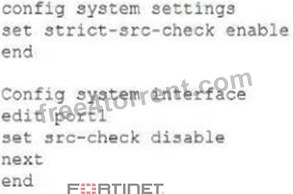
What would be the impact of this configuration on FortiGate?
- A. FortiGate will enable strict RPF on ail its interfaces and port1 will be enable for asymmetric routing.
- B. The global configuration will take precedence and FortiGate will enable strict RPF on all interfaces.
- C. FortiGate will enable strict RPF on all its interfaces and port1 will be exempted from RPF checks.
- D. Port1 will be enabled with flexible RPF, and all other interfaces will be enabled for strict RPF
Answer: C
Explanation:
The global setting enables strict source checking (RPF) on all interfaces by default. The per- interface setting disables the source check on port1, exempting it from strict RPF enforcement.
NEW QUESTION # 47
Refer to the exhibit, which shows a firewall policy to enable active authentication.
When attempting to access an external website using an active authentication method, the user is not presented with a login prompt.
What is the most likely reason for this situation?
- A. The Remote-users group is not added to the Destination.
- B. No matching user account exists for this user.
- C. The Remote-users group must be set up correctly in the FSSO configuration.
- D. The Service DNS is required in the firewall policy.
Answer: D
Explanation:
For active authentication (such as captive portal) to trigger, the FortiGate must intercept the user's initial web request. This requires DNS traffic to pass through the FortiGate so it can redirect the request to the login page. If the firewall policy does not include the DNS service, the user's browser resolves domains directly, and the authentication portal is never triggered.
NEW QUESTION # 48
An administrator has configured a dialup IPsec VPN on FortiGate with add-route enabled.
However, the static route is not showing in the routing table.
Which two statements about this scenario are correct? (Choose two.)
- A. The administrator must enable a dynamic routing protocol on the dialup interface.
- B. The administrator must ensure phase 2 is successfully established.
- C. The administrator must define the remote network correctly in the phase 2 selectors.
- D. The administrator must use a policy route instead of a static route for add-route to work properly.
Answer: B,C
Explanation:
The administrator must ensure phase 2 is successfully established → The static route for the dialup VPN is only added after Phase 2 negotiation completes successfully.
The administrator must define the remote network correctly in the phase 2 selectors → The add- route feature installs a route based on the Phase 2 selectors; if they are incorrect, no route will appear in the routing table.
NEW QUESTION # 49
An administrator configured a FortiGate device to act as a collector for agentless polling mode.
What must the administrator add to the FortiGate device to retrieve AD user group information?
- A. Keycloak server
- B. RADIUS server
- C. TACACS server
- D. LDAP server
Answer: D
Explanation:
In agentless polling mode, FortiGate directly queries Active Directory to obtain user and group information. To do this, the administrator must configure an LDAP server on the FortiGate, which allows it to retrieve user group membership details from AD.
NEW QUESTION # 50
Refer to the exhibits. An administrator wants to add HQ-ISFW-2 in the Security Fabric. HQ-ISFW-
2 is in the same subnet as HQ-ISFW. After configuring the Security Fabric settings on HQ-ISFW-
2, the status stays Pending.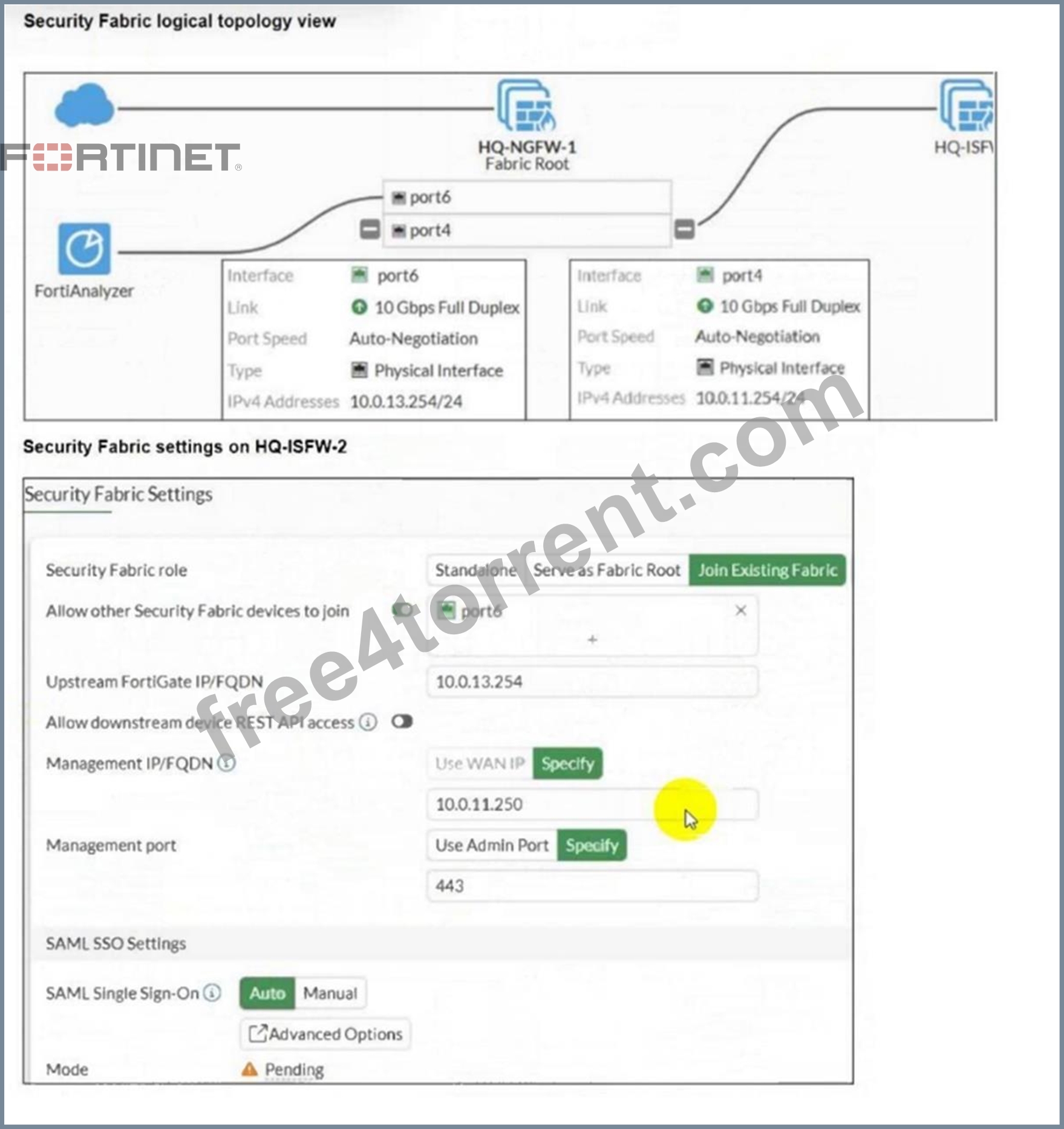
What can be the two possible reasons? (Choose two.)
- A. Upstream FortiGate IP must be set to 10.0.11.254.
- B. HQ-ISFW-2 must be authorized on HQ-ISFW.
- C. SAML Single Sign-On must be set to Manual.
- D. Management IP must be set to 10.0.13.254.
Answer: A,B
Explanation:
The Upstream FortiGate IP should match the IP address of the Fabric Root interface, which is
10.0.11.254, not 10.0.13.254.
The new device (HQ-ISFW-2) must be authorized on the Fabric Root (HQ-ISFW) before it can join the Security Fabric, otherwise the status remains pending.
NEW QUESTION # 51
Refer to the exhibits. Based on the current HA status, an administrator updates the override and priority parameters on HQ-NGFW-1 and HQ-NGFW-2 as shown in the exhibit.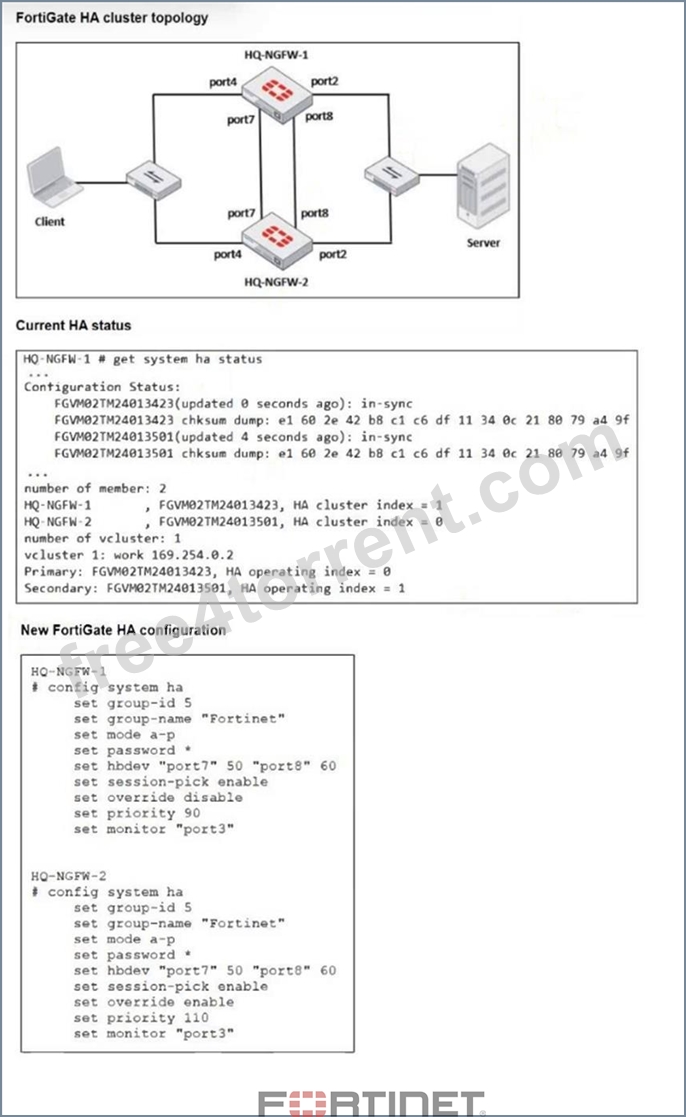
What would be the expected outcome in the HA cluster?
- A. HQ-NGFW-2 will take over as the primary because it has the override enable setting and higher priority than HQ-NGFW-1.
- B. HQ-NGFW-1 will synchronize the override disable setting with HQ-NGFW-2.
- C. HQ-NGFW-1 will remain the primary because HQ-NGFW-2 has lower priority.
- D. The HA cluster will become out of sync because the override setting must match on all HA members.
Answer: A
Explanation:
With override enabled on HQ-NGFW-2 and its higher priority (110 vs. 90), HQ-NGFW-2 will become the primary device, preempting HQ-NGFW-1 despite the current primary status.
NEW QUESTION # 52
A network administrator has enabled full SSL inspection and web filtering on FortiGate. When visiting any HTTPS websites, the browser reports certificate warning errors. When visiting HTTP websites, the browser does not report errors.
What is the reason for the certificate warning errors?
- A. The option invalid SSL certificates is set to allow on the SSL/SSH inspection profile
- B. The matching firewall policy is set to proxy inspection mode.
- C. The certificate used by FortiGate for SSL inspection does not contain the required certificate extensions.
- D. The browser does not trust the certificate used by FortiGate for SSL inspection.
Answer: D
Explanation:
When full SSL inspection is enabled, FortiGate decrypts and re-signs HTTPS traffic using its own SSL inspection certificate. If the FortiGate CA certificate is not imported and trusted by the client's browser or OS, the browser sees it as untrusted and displays certificate warning errors. HTTP traffic is unaffected since it does not use certificates.
NEW QUESTION # 53
An administrator notices that some users are unable to establish SSL VPN connections, while others can connect without any issues.
What should the administrator check first?
- A. Ensure that the affected users are using the correct port number.
- B. Ensure that forced tunneling is enabled to reroute all traffic through the SSL VPN
- C. Ensure that user traffic is hitting the firewall policy.
- D. Ensure that the HTTPS service is enabled on SSL VPN tunnel interface
Answer: C
Explanation:
If user traffic is not matching the appropriate firewall policy that permits SSL VPN, users will be unable to establish connections, making this the first aspect to verify.
NEW QUESTION # 54
Refer to the exhibit. Which two statements are true about the routing entries in this database table? (Choose two.)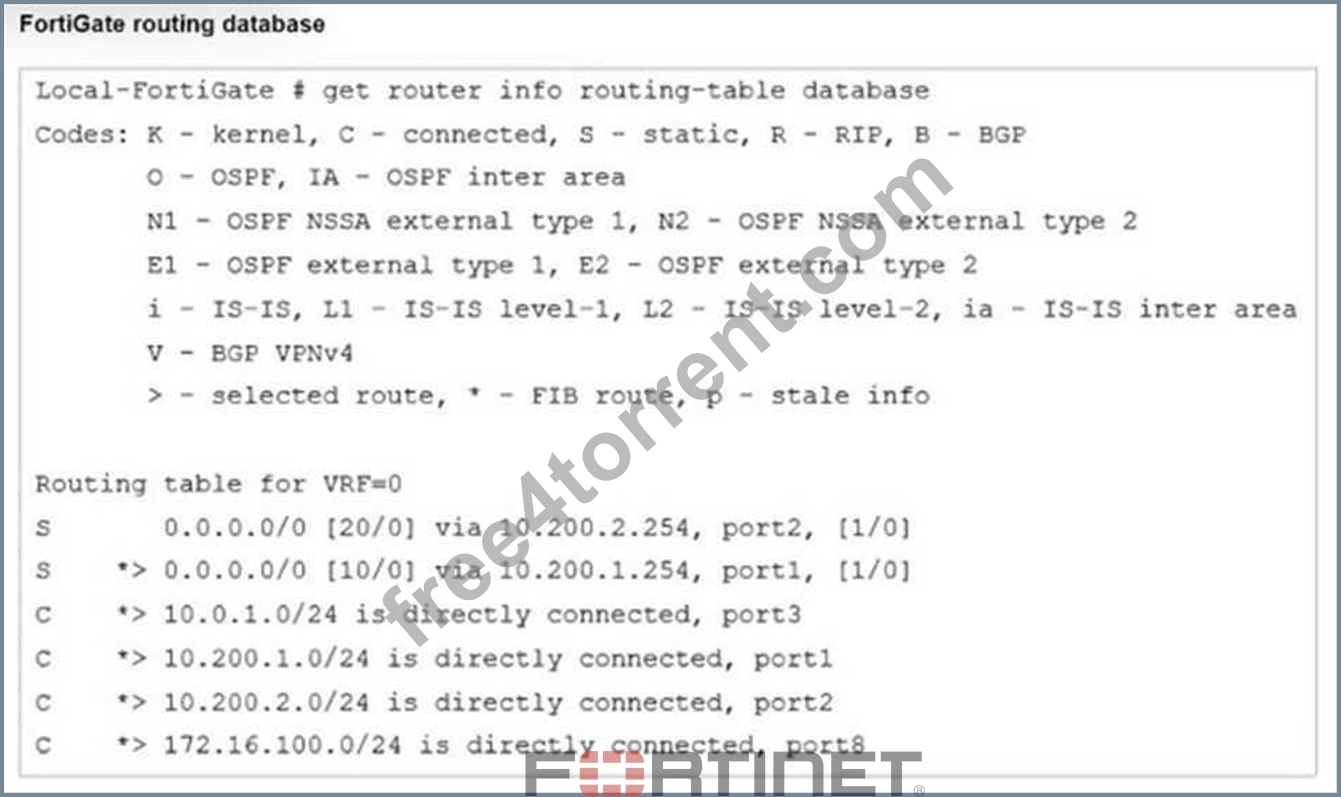
- A. All of the entries in the routing database table are installed in the FortiGate routing table.
- B. The default route on port2 is marked as the standby route.
- C. The port2 interface is marked as inactive.
- D. Both default routes have different administrative distances.
Answer: B,D
Explanation:
The routing table in the exhibit shows two default routes (0.0.0.0/0) with different administrative distances:
The default route through port2 has an administrative distance of 20. The default route through port1 has an administrative distance of 10. Administrative distance determines the priority of the route; a lower value is preferred. Here, the route through port1 with an administrative distance of
10 is the preferred route. The route through port2 with an administrative distance of 20 acts as a standby or backup route. If the primary route (port1) fails or is unavailable, traffic will then be routed through port2. Regarding the statement that the port2 interface is marked as inactive, there is no indication in the routing table that port2 is inactive. Similarly, all the routes displayed are not necessarily installed in the FortiGate routing table, as the table could include both active and backup routes.
NEW QUESTION # 55
Refer to the exhibits. An administrator configured the Web Filter Profile to block access to all social networking sites except Facebook. However, when users try to access Facebook.com, they are redirected to a FortiGuard web filtering block page.
Based on the exhibits, which configuration change must the administrator make to allow Facebook while blocking all other social networking sites?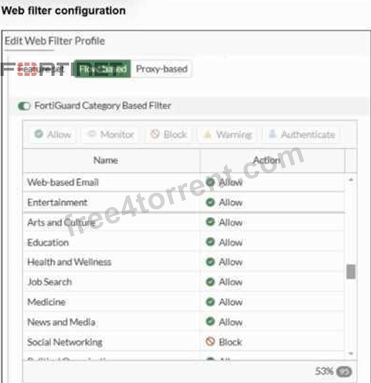
- A. Change the Feature set of Web Filter Profile as Proxy-based.
- B. Change the type as Simple in the Static URL Filter section.
- C. Set the Action as Exempt for www.facebook.com
in the Static URL Filter. - D. Set the Social Networking action as warning in the FortiGuard Category Based Filter.
Answer: C
NEW QUESTION # 56
An administrator wanted to configure an IPS sensor to block traffic that triggers a signature set number of times during a specific time period.
How can the administrator achieve the objective?
- A. Use IPS group signatures, set rate-mode 60.
- B. Use IPS filter, rate-mode periodical option.
- C. Use IPS filter, rate-mode periodical option.
- D. Use IPS packet logging option with periodical filter option.
Answer: B
Explanation:
The IPS filter with the rate-mode set to "periodical" allows the administrator to block traffic that triggers a signature a specified number of times within a defined time period, meeting the requirement.
NEW QUESTION # 57
A new administrator is configuring FSSO authentication on FortiGate using DC Agent Mode.
Which step is NOT part of the expected process?
- A. The collector agent forwards login event data to FortiGate.
- B. The DC agent sends login event data directly to FortiGate.
- C. The user logs into the windows domain.
- D. FortiGate determines user identity based on the IP address in the FSSO list.
Answer: A
Explanation:
In DC Agent Mode, the DC agent sends login event data directly to FortiGate without involving a collector agent.
NEW QUESTION # 58
An administrator wants to configure dead peer detection (DPD) on IPsec VPN for detecting dead tunnels. The requirement is that FortiGate sends DPD probes only when there is no inbound traffic.
Which DPD mode on FortiGate meets this requirement?
- A. Enabled
- B. On Idle
- C. On Demand
- D. Disabled
Answer: C
Explanation:
Disable: Disable Dead Peer Detection.
On-idle: Trigger Dead Peer Detection when no IPsec traffic is received.
On-demand: Trigger Dead Peer Detection when no IPsec traffic is received AND FortiGate has been sending IPsec traffic. On-demand is the default setting.
NEW QUESTION # 59
Which two statements are correct when FortiGate enters conserve mode? (Choose two.)
- A. FortiGate continues to run critical security actions, such as quarantine.
- B. FortiGate halts complete system operation and requires a reboot to regain available resources.
- C. FortiGate continues to transmit packets without IPS inspection when the fail-open global setting in IPS is enabled.
- D. FortiGate refuses to accept configuration changes.
Answer: C,D
Explanation:
In conserve mode, FortiGate restricts configuration changes to preserve system stability. When IPS fail-open is enabled, FortiGate continues forwarding traffic without IPS inspection during resource constraints (conserve mode).
NEW QUESTION # 60
You want to ensure that an SSL VPN user's authenticated session does not remain active after they disconnect from the VPN.
Which configuration will ensure this?
- A. Manually clear active firewall authentication sessions after a user disconnects.
- B. Increase the SSL VPN idle timeout to reduce the chance of early disconnections.
- C. Enable settings to force the firewall authentication session to end when the SSL VPN session ends
- D. Configure the firewall authentication session timeout to be lower than the SSL VPN session timeout.
Answer: C
Explanation:
To ensure that an authenticated SSL VPN user session does not persist after disconnecting, you must enable the setting that forces the firewall authentication session to end when the SSL VPN session ends. This ensures that once the VPN disconnects, the associated firewall authentication state is immediately cleared, preventing unintended access.
NEW QUESTION # 61
Which statement correctly describes NetAPI polling mode for the FSSO collector agent?
- A. The collector agent uses a Windows API to query DCs for user logins.
- B. NetAPI polling can increase bandwidth usage in large networks.
- C. The NetSessionEnum function is used to track user logouts.
- D. The collector agent must search Windows application event logs.
Answer: B
Explanation:
NetAPI polling mode involves frequent queries to domain controllers, which can cause increased bandwidth usage, especially in large networks with many login events.
NEW QUESTION # 62
A FortiGate firewall policy is configured with active authentication, however, the user cannot authenticate when accessing a website.
Which protocol must FortiGate allow even though the user cannot authenticate?
- A. Kerberos
- B. TACASC+
- C. LDAP
- D. DNS
Answer: D
Explanation:
DNS traffic must be allowed so the user can resolve domain names and reach the authentication server or web resources, even if authentication initially fails.
NEW QUESTION # 63
Refer to the exhibits. The exhibits show a diagram of a FortiGate device connected to the network, as well as the IP pool configuration and firewall policy objects.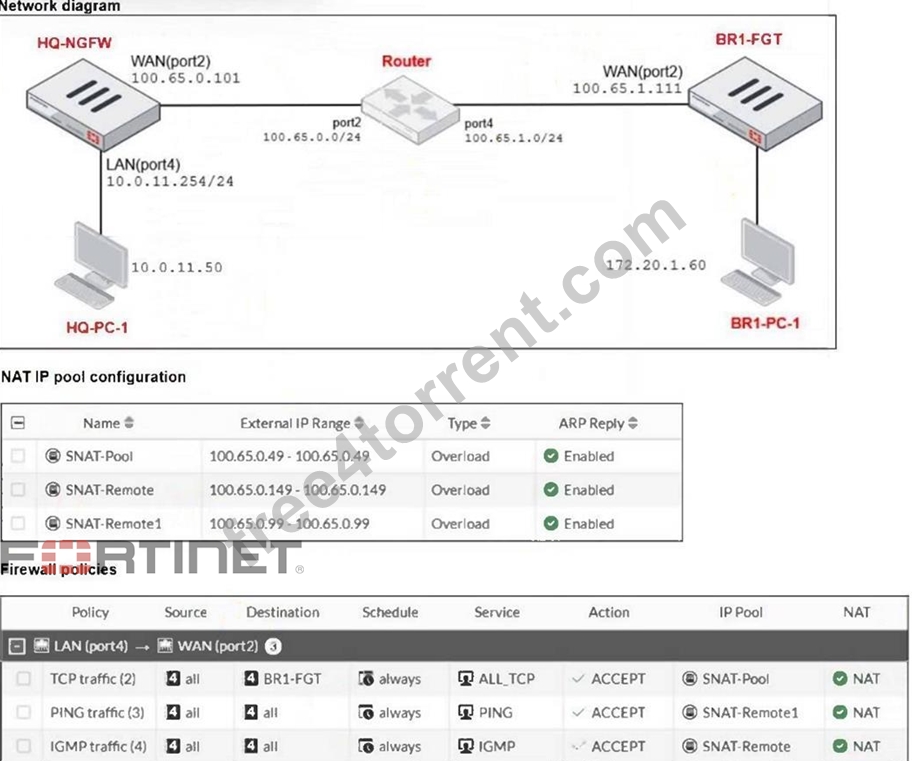
The WAN (port2) interface has the IP address 100.65.0.101/24. The LAN (port4) interface has the IP address 10.0.11.254/24. Which IP address will be used to source NAT (SNAT) the traffic, if the user on HQ-PC-1 (10.0.11.50) pings the IP address of BR-FGT (100.65.1.111)
- A. 100.65.0.49
- B. 100.65.0.149
- C. 100.65.0.101
- D. 100.65.0.99
Answer: D
Explanation:
The ping traffic policy uses the IP pool named SNAT-Remote1, which has the external IP range
100.65.0.99. Therefore, traffic matching this policy (ping from HQ-PC-1 to BR1-FGT) will use
100.65.0.99 for source NAT.
NEW QUESTION # 64
Refer to the exhibit. FortiGate has two separate firewall policies for Sales and Engineering to access the same web server with the same security profiles.
Which action must the administrator perform to consolidate the two policies into one?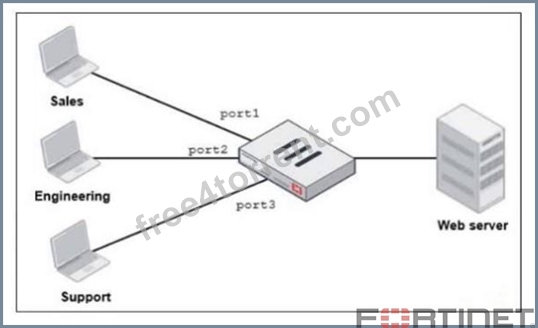
- A. Replace port1 and port2 with the any interface in a single firewall policy.
- B. Select port1 and port2 subnets in a single firewall policy.
- C. Enable Multiple Interface Policies to select port1 and port2 in the same firewall policy.
- D. Create an Aggregate interface that includes port1 and port2 to create a single firewall policy.
Answer: C
Explanation:
Enabling Multiple Interface Policies allows you to select multiple interfaces (like port1 and port2) in a single firewall policy, consolidating access rules for both Sales and Engineering to the web server.
NEW QUESTION # 65
......
Free NSE4_FGT_AD-7.6 Dumps are Available for Instant Access: https://realtest.free4torrent.com/NSE4_FGT_AD-7.6-valid-dumps-torrent.html