

Download Free Fortinet FCSS_LED_AR-7.6 Real Exam Questions Download
Latest Fortinet FCSS_LED_AR-7.6 Real Exam Dumps PDF
NEW QUESTION # 59
In FortiManager CLI, how do you enable FortiAIOps monitoring?
Response:
- A. config system aiops → set enable
- B. FortiAIOps is enabled by default in managed mode
- C. config aiops settings → set collection-mode full
- D. config system global → set ai-monitor enable
Answer: B
NEW QUESTION # 60
Which CLI automation action on FortiGate is used to define automatic quarantine based on event logs?
Response:
- A. config system automation-action → set action quarantine
- B. config user quarantine → set auto-log enable
- C. config log setting → set quarantine enable
- D. config automation-stitch → set action-type quarantine-host
Answer: D
NEW QUESTION # 61
In a Zero-Touch Provisioning (ZTP) deployment, which device typically initiates the connection to FortiManager?
Response:
- A. FortiGate
- B. FortiAuthenticator
- C. FortiAP
- D. FortiSwitch
Answer: A
NEW QUESTION # 62
Refer to the exhibits.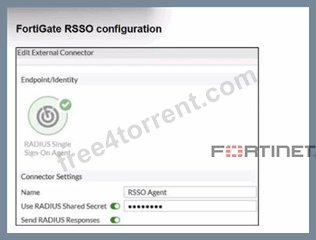
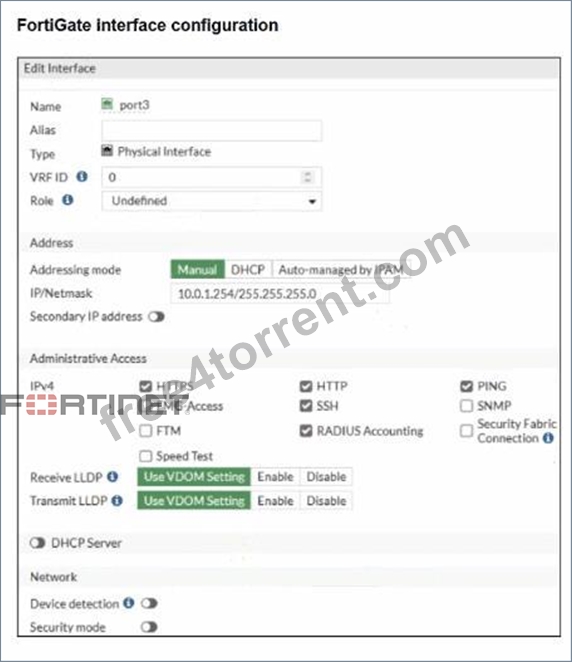
Examine the FortiGate RSSO configuration shown in the exhibit.
FortiGate is set up to use RSSO for user authentication. It is currently receiving RADIUS accounting messages through port3. The incoming RADIUS accounting messages contain the username in the User- Name attribute and group membership in the Class attribute. You must ensure that the users are authenticated through these RADIUS accounting messages and accurately mapped to their respective RSSO user groups.
Which three critical configurations must you implement on the FortiGate device? (Choose three.)
- A. The RADIUS Attribute Value setting configured for an RSSO user group should match the class RADIUS attribute value in the RADIUS accounting message.
- B. RSSO user groups should be assigned to all firewall policies.
- C. The rsso-endpoint-attribute CLI setting in the RSSO agent configuration should be set to User-Name.
- D. Device detection and Security Fabric Connection should be enabled on port3
- E. The sso-attribute CLI setting in the RSSO agent configuration should be set to Class.
Answer: A,C,E
Explanation:
The problem states:
* FortiGate receivesRADIUS accounting messagesonport3.
* User-Nameattribute contains the username.
* Classattribute contains the group membership.
* Goal: authenticate users through RSSO and map them to the correct user groups.
To achieve this, three critical components must be configured:
#A. RADIUS Attribute Value in the RSSO group must match the Class attribute This is mandatory because:
* RSSO user groups on FortiGate match users based onthe value inside the RADIUS attribute(usually Class).
* For group assignment to work, FortiGate must compare:
RSSO User Group # RADIUS Class Attribute Value
This isexactly how FortiGate maps RSSO users to groups.
#D. RSSO agent's sso-attribute must be set to Class
Thesso-attributedefineswhich RADIUS attribute contains the group information.
Because group membership is carried in:
#Class attribute
You must configure:
config user radius
set sso-attribute Class
end
This tells FortiGate:
"Use the Class attribute to derive user group membership."
#E. rsso-endpoint-attribute must be set to User-Name
This identifieswhich RADIUS attributecarries the actualusername.
In this scenario:
* RADIUS accounting messages contain the username inUser-Name.
* So the correct setting is:
config user radius
set rsso-endpoint-attribute User-Name
end
This ensures the RSSO user object uses the correct username.
#Incorrect Options Explained
B). Assign RSSO user groups to all firewall policies
Not required.
You only assign them to policies where RSSO authentication is used.
C). Device detection and Security Fabric Connection should be enabled on port3 Totally irrelevant to RSSO.
RSSO only needs RADIUS accounting, not device detection or Fabric services.
NEW QUESTION # 63
You are configuring FortiAuthenticator to integrate with FSSO for user identification. To enable FortiAuthenticator to extract user information from syslog messages and inject it into FSSO, you have configured syslog matching rules.
What is the role of syslog matching rules in the process of injecting user information into FSSO?
- A. To define how syslog messages are parsed and extract user information, such as usernames and IP addresses
- B. To automatically update user group memberships in FSSO based on syslog events
- C. To enforce user authentication policies based on syslog message contents
- D. To filter and block irrelevant syslog messages from being processed by the FortiAuthenticator
Answer: A
Explanation:
When FortiAuthenticator is used as anFSSO agentbased onsyslog, it must:
* Parse incoming syslog messagesfrom devices (firewalls, WLAN controllers, VPN concentrators, etc.).
* Extract identity fieldssuch as:
* Username
* IP address
* Login/logout event indicators
Syslogmatching ruleson FortiAuthenticator define:
* Which syslog messages are relevant (by facility, message pattern, or regex).
* How to capture specific fields (username, IP, group, event type).
FortiAuthenticator then uses this parsed data toinject logon sessions into FSSO, so FortiGate can apply identity-based policies.
Thus, the role of syslog matching rules is exactly as described inC.
* A: Group mapping is handled separately via directory groups / FSSO config, not directly by matching rules.
* B: Enforcement of authentication policies is done on FortiGate, not directly by the matching rules.
* D: While irrelevant logs can be ignored via rules, the primary purpose isparsing and extraction, not generic filtering.
NEW QUESTION # 64
What are the benefits of managing FortiSwitch using FortiManager over FortiLink?
(Choose two)
Response:
- A. Centralized policy and template deployment
- B. Backup configuration versioning
- C. CLI-only control for all switches
- D. Requirement for separate FortiAnalyzer
Answer: A,B
NEW QUESTION # 65
Refer to the exhibits.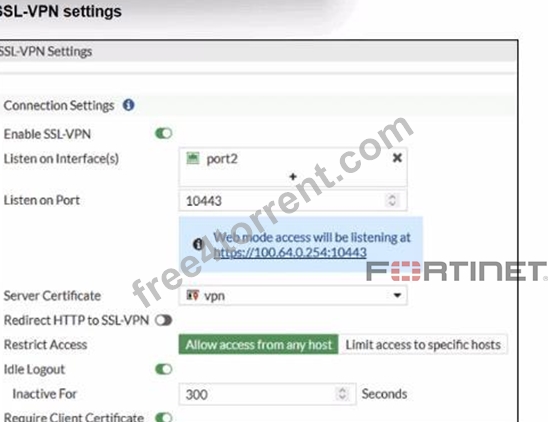
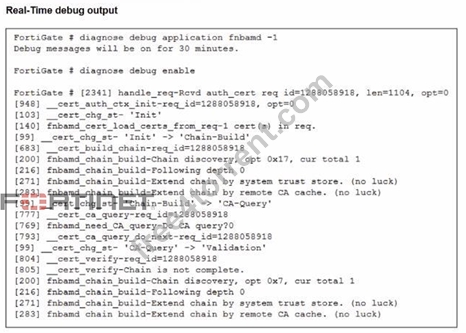
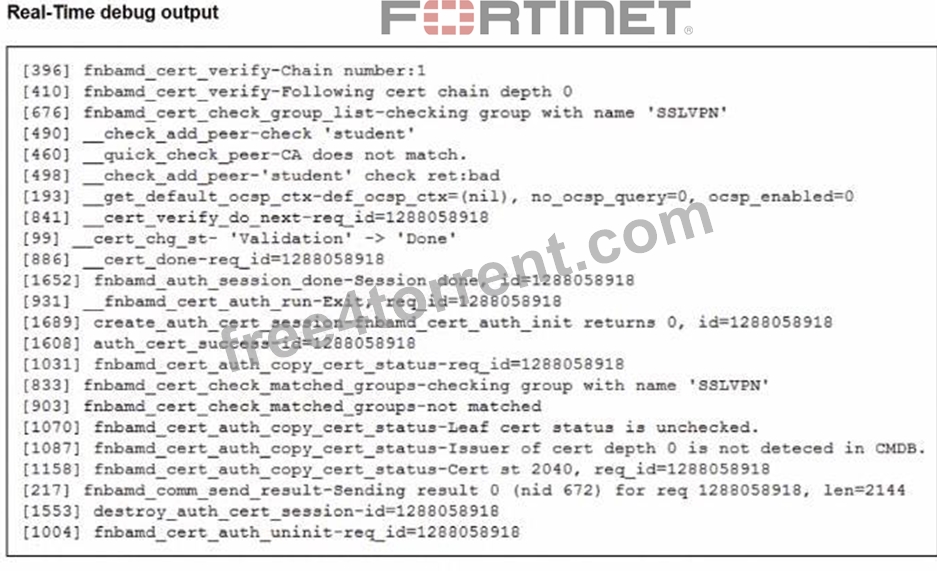
Which include debug output and SSL VPN configuration details.
An SSL VPN has been configured on FortiGate. To enhance security, the administrator enabled Required Client Certificate in the SSL VPN settings. However, when a user attempts to connect, authentication fails.
Which configuration change is needed to fix the issue and allow the user to connect?
- A. Import the CA that signed the user certificate to FortiGate.
- B. Set the user certificate as the Server Certificate on the SSL VPN configuration page.
- C. Enable Redirect HTTP to SSL-VPN on the SSL VPN configuration page.
- D. Import the CA that signed the SSL VPN Server Certificate to FortiGate.
Answer: A
Explanation:
The SSL-VPN configuration hasRequire Client Certificateenabled. When this is enabled, FortiOS performs two checks:
* Normal user authentication(username/password or PKI user)
* Additional client certificate check- the client certificatemust be signed by a CA that FortiGate trusts FortiOS documentation for "SSL VPN with certificate authentication" states:
* "The client certificate only needs to be signed by a known CA in order to pass authentication."
* "The CA certificate is the certificate that signed both the server certificate and the user certificate...
The CA certificate is available to be imported on the FortiGate."
The debug output shows key lines:
* __quick_check_peer-CA does not match.
* Issuer of cert depth 0 is not detected in CMDB.
This tells us:
* FortiGatedoes see the user's certificate,
* Butcannot find the issuing CAin its local CA certificate store ("CMDB" = configuration database).
This means theCA that signed the user certificate has not been importedinto FortiGate.
Now evaluate the options:
* A. Enable Redirect HTTP to SSL-VPN- affects only redirection from HTTP to HTTPS; it has nothing to do with certificate validation.
* B. Import the CA that signed the SSL VPN Server Certificate- the server certificate is already working (the portal comes up) and its CA is not what the debug complains about; the error is about the peer (user) certificate. Often the same CA signs both, but the failing check specifically says the issuer of the client cert is not in CMDB.
* C. Set the user certificate as the Server Certificate- incorrect; server and client certificates serve different roles.
* D. Import the CA that signed the user certificate to FortiGate- this directly addresses the debug error and aligns with the documented requirement that the CA which issued the user certificate must be known to FortiGate.
NEW QUESTION # 66
What is the expected behavior when enabling auto TX power control on a FortiAP interface?
- A. FortiGate monitors the signal strength of nearby AP interfaces and adjusts its own transmit power every
30 seconds to match the signal strength of the adjacent AP - B. The AP periodically evaluates the signal strength of its own transmission from the client perspective and adjusts its power to ensure the signal is detected at -70 dBm.
- C. FortiGate periodically measures the signal strength of the weakest associated client and adjusts the AP radio power to align with the detected signal strength of that client.
- D. FortiGate measures the signal strength of nearby FortiAP interfaces every 30 seconds and adjusts their transmit power to ensure they remain detectable at -70 dBm.
Answer: C
Explanation:
Auto TX power control on FortiAP is an RF-optimization feature:
* FortiGate (as wireless controller) continuously evaluatesRSSI of associated clientson each FortiAP radio.
* The algorithm focuses on theweakest client(the one with the worst signal) and adjusts the AP's transmit power so that this client's signal level stays within a configured / target range.
* This helps balance coverage and limit co-channel interference: APs don't transmit at maximum power when clients are close, but will increase power when the weakest client signal drops too low.
Therefore the correct behavior description is:
#C- AP power is adjusted based on the weakest associated client's signal.
Why the others are wrong:
* AandBtalk about matching nearby APs' power or forcing everything to -70 dBm, which is not how FortiAP auto TX works.
* Dincorrectly states the AP "evaluates its own transmission from the client perspective"; the AP can only infer client-side conditions from theclient's RSSI at the AP, not the inverse.
NEW QUESTION # 67
Which field in a RADIUS accounting message is used by FortiAuthenticator for RSSO group assignment?
Response:
- A. User-Password
- B. NAS-Identifier
- C. Filter-ID
- D. Calling-Station-ID
Answer: C
NEW QUESTION # 68
Refer to the exhibits.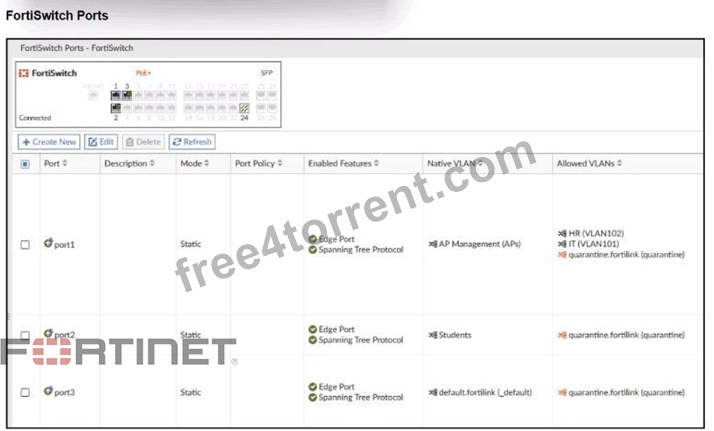
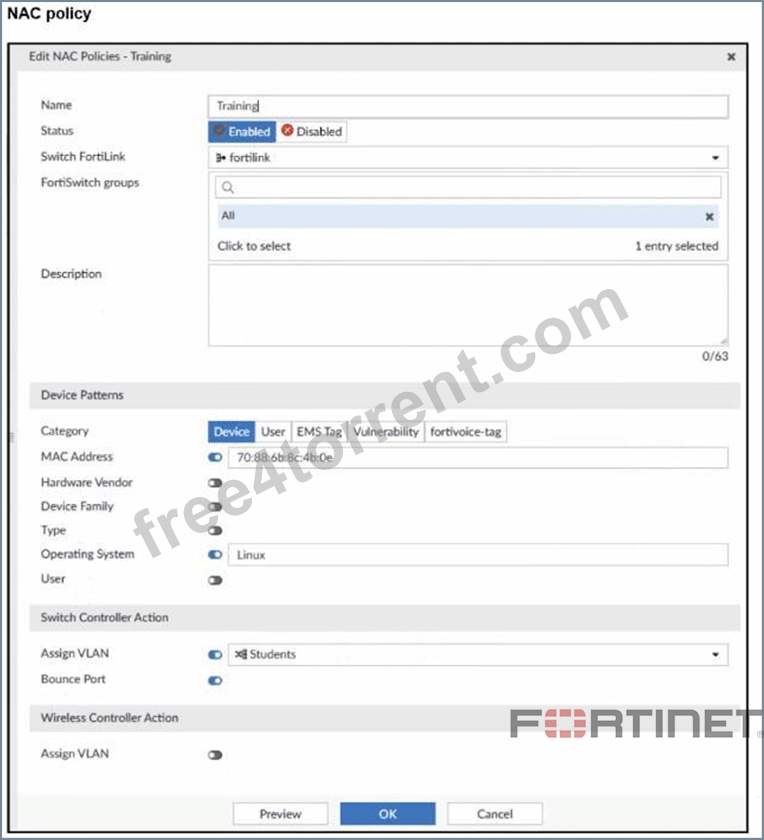
A NAC policy has been configured to apply traffic that flows through FortiSwitch port 2. Traffic that meets the NAC policy criteria will be assigned to the Students VLAN. However, the NAC policy does not seem to be taking effect.
Which configuration is missing?
- A. The Students VLAN should be set to Allowed VLANs instead of Native VLAN.
- B. Port2 Access mode should be set to NAC mode.
- C. The MAC address or OS might be misconfigured for the connected device.
- D. Port2 Access mode should be set to Port Policy mode.
Answer: B
Explanation:
From the exhibits:
* FortiSwitch Ports viewshows:
* port2
* Mode: Static
* Native VLAN: Students
* Allowed VLANs: quarantine.fortilink (quarantine)
* NAC policy "Training":
* Switch FortiLink: fortilink
* Category:Device
* Matching criteria:
* MAC Address: 70:88:6b:8c:4b:0e (enabled)
* Operating System:Linux(enabled)
* Switch Controller Action:
* Assign VLAN = Students
* Bounce Port = enabled
Design intent:
Device with that MAC + OS Linux, when plugged intoport2, should be dynamically moved to VLAN Studentsby the NAC policy.
Why it doesn't work now
On FortiLink NAC,dynamic NAC decisions only apply on ports whose "Access Mode" is set to NAC:
* NAC mode = FortiGate controls theonboarding VLAN, evaluates NAC policies, and then dynamically reassigns the switch port VLAN (access, quarantine, etc.).
* Static mode(what we see on port2) means the port just uses its configurednative/allowed VLANs, and no NAC classificationhappens.
Right now:
* port2 is astatic access portwith Native VLAN = Students.
* The NAC policy exists, butFortiSwitch is not in NAC enforcement mode on that port, so the policy is never evaluated for traffic on port2.
Therefore, themissing configurationis:
Setport2toNAC mode(sometimes called "Access mode: NAC" or "NAC LAN edge port").
Once port2 is changed to NAC mode:
* Device initially lands in the onboarding/quarantine VLAN.
* FortiGate collects device info (MAC, OS, etc.).
* NAC policy "Training" matches MAC + Linux.
* Switch controller actionAssign VLAN = Studentsis applied.
* Port is bounced (if configured), bringing the device back up in VLAN Students.
Why the other options are wrong
* B. MAC or OS misconfigured
* Possible in general, but the question asks forwhich configuration is missing, and the exhibits clearly focus on port mode. Also, even with wrong MAC/OS, the port would still be in NAC mode; here NAC isn't even active.
* C. Port Policy mode
* Port policy (edge/trunk) is separate from NAC; NAC requires the specificNAC access mode.
* D. Students VLAN should be Allowed VLANs instead of Native VLAN
* For an access port, having Students as thenative VLANis correct. NAC policy's Assign VLAN will set that as access VLAN; no need to make it an allowed trunk VLAN.
NEW QUESTION # 69
Which two configuration steps are needed to enforce authentication for guest access?
(Choose two)
Response:
- A. Define guest portal URL
- B. Assign VLANs manually
- C. Create a firewall policy with captive portal
- D. Enable endpoint discovery
Answer: A,C
NEW QUESTION # 70
Which configuration file or setting should be modified to enable OCSP checking for certificate revocation on FortiAuthenticator?
Response:
- A. radiusd.conf
- B. syslog.conf
- C. LDAP bind profile
- D. Certificate Validation Policy
Answer: D
NEW QUESTION # 71
Which of the following components are involved in Fortinet Zero-Touch Provisioning architecture?
(Choose three)
Response:
- A. FortiManager
- B. FortiSwitch
- C. FortiDeploy
- D. FortiCloud
Answer: A,C,D
NEW QUESTION # 72
Refer to the exhibits.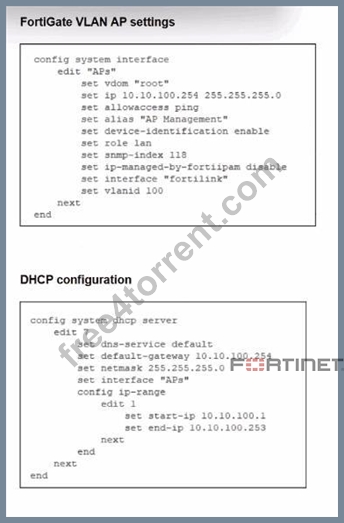
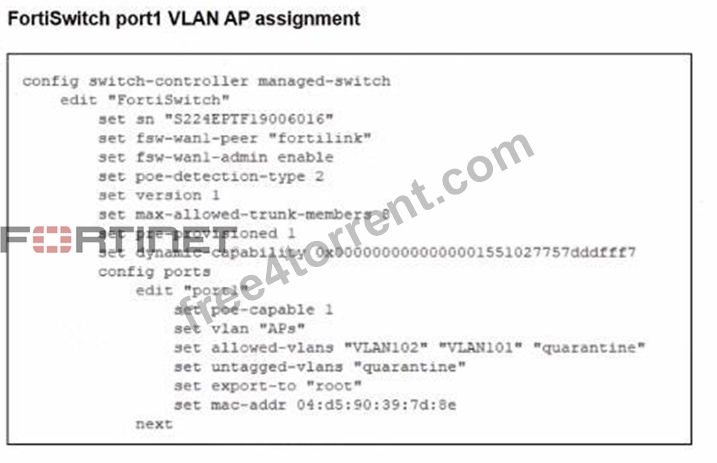
A FortiSwitch is successfully managed by a FortiGate. FortiAP is connected to port1 of the managed FortiSwitch. On FortiGate, the VLAN AP is configured to detect and manage FortiAP, along with a DHCP server for the VLAN AP. Additionally, the VLAN AP is assigned to port1 of FortiSwitch. However.
FortiGate is unable to detect or manage FortiAP.
Which FortiGate misconfiguration is preventing the detection of FortiAP?
- A. The CAPWAP ports (UDP 5246 and 5247) are not open on FortiGate.
- B. Security Fabric is disabled in the administrative access options of the VLAN.
- C. The FortiAP firmware is incompatible with the FortiGate firmware version.
- D. The VLAN is not tagged correctly on the FortiSwitch uplink port.
Answer: B
Explanation:
From the exhibits:
* Interface"APs"is a VLAN sub-interface onfortilinkwith IP10.10.100.254/24and a DHCP server scope
10.10.100.1-10.10.100.253.
* This VLAN is assigned toport1on the managed FortiSwitch for FortiAPs.
* The interface config showsonly allowaccess ping-Security Fabric Connection is not enabled.
In LAN Edge designs, FortiAPs connected through FortiSwitch are discovered and managed asLAN edge devices of the Security Fabric. FortiOS documentation states that FortiAPs and FortiSwitches appear in the Fabric topologyonly when connected on an interface with Security Fabric Connection enabled.
If the VLAN/AP management interface lacksSecurity Fabric Connection:
* FortiGate does not treat that network as aFabric connection segment.
* CAPWAP discovery from FortiAPs on that VLAN will not result in the AP being onboarded and shown for management.
Therefore the key misconfiguration is:
#A - Security Fabric is disabled on the VLAN interface used for AP management.
Why the others are not the root cause:
* B. Firmware incompatibility- would usually show as a "Managed (upgrade required)" or similar status after discovery, not complete non-detection. The scenario specifically points to a configuration issue, not firmware.
* C. VLAN not tagged correctly on uplink- The FortiSwitch uplink to FortiGate is the FortiLink trunk, and the VLAN sub-interface APs is already bound to fortilink, so tagging on the uplink is correct by definition.
* D. CAPWAP ports not open- CAPWAP (UDP 5246/5247) is terminated locally on FortiGate and does not depend on any firewall policy; these ports are open on the FortiGate itself by default.
NEW QUESTION # 73
Refer to the exhibit.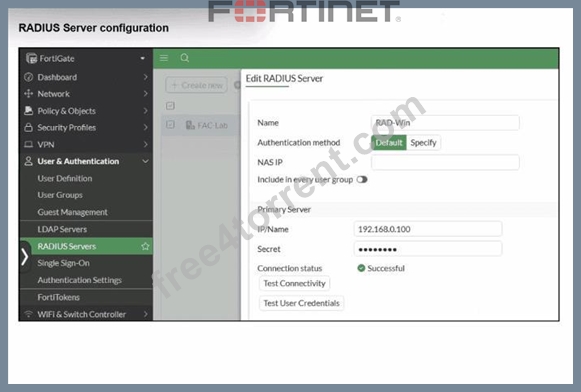
On FortiGate, a RADIUS server is configured to forward authentication requests to FortiAuthenticator, which acts as a RADIUS proxy. FortiAuthenticator then relays these authentication requests to a remote Windows AD server using LDAP.
While testing authentication using the CLI command diagnose test authserver. the administrator observed that authentication succeeded with PAP but failed when using MS-CHAFV2.
Which two solutions can the administrator implement to enable MS-CHAPv2 authentication? (Choose two.)
- A. Enable RADIUS attribute filtering on FortiAuthenticator.
- B. Enable Windows Active Directory domain authentication on FortiAuthenticator.
- C. Configure FortiAuthenticator to use RADIUS instead of LDAP as the back-end authentication server
- D. Change the FortiGate authentication method to CHAP instead of MS-CHAPv2.
Answer: C,D
NEW QUESTION # 74
Which three conditions can FortiLink NAC use to enforce network access control?
(Choose three)
Response:
- A. User identity
- B. Interface MTU
- C. Device type
- D. MAC address
- E. Switch stack priority
Answer: A,C,D
NEW QUESTION # 75
What must be done on the FortiGate to fully enable RSSO with FortiAuthenticator?
Response:
- A. Disable RSSO attribute
- B. Set RADIUS client IP
- C. Add syslog filter
- D. Enable RSSO on user group
Answer: D
NEW QUESTION # 76
A network administrator connects a new FortiGate to the network, allowing it to automatically discover andI register with FortiManager.
What occurs after FortiGate retrieves the FortiManager address?
- A. FortiGate sends a discovery request to all devices on the local network using UDP port 1068.
- B. The device needs to be manually authorized on FortiManager.
- C. FortiGate establishes a secure tunnel to FortiManager over TCP port 541.
- D. FortiGate configures its interface settings based on a DHCP response from FortiManager.
Answer: C
Explanation:
When a FortiGate is deployed usingZero Touch Provisioning (ZTP)or auto-discovery:
* FortiGate retrieves theFortiManager IP address(from DHCP Option 240, FortiCloud/ZTNA provisioning, or manual set).
* The next step isnot UI authorizationor DHCP changes-it immediately attempts to form aFGFM (FortiGate-FortiManager) tunnel.
* The FGFM protocol usesTCP port 541to establish a secure management channel.
FortiManager will still require manual authorization of the deviceinside FortiManager, but this occursafter the tunnel is established.
Therefore, the first automatic action after retrieving the FMG address iscreating the secure FGFM tunnel on TCP/541.
NEW QUESTION # 77
Which CLI command checks the FortiLink status for connected FortiSwitches?
Response:
- A. diagnose sys link-monitor
- B. diagnose hardware switch
- C. diagnose switch-controller switch-info
- D. get switch status
Answer: C
NEW QUESTION # 78
Which FortiAnalyzer dashboard provides AIOps-related summaries and alerts?
Response:
- A. Fabric View > AI-Powered Insights
- B. Incidents & Events > AIOps
- C. FortiView > System Events
- D. Log View > Threats
Answer: B
NEW QUESTION # 79
What is the primary function of FortiAIOps in a LAN Edge deployment?
Response:
- A. Collect NetFlow data
- B. Deploy firmware updates
- C. Monitor application-layer firewalls
- D. Correlate and analyze operational data using AI
Answer: D
NEW QUESTION # 80
......
PDF (New 2025) Actual Fortinet FCSS_LED_AR-7.6 Exam Questions: https://realtest.free4torrent.com/FCSS_LED_AR-7.6-valid-dumps-torrent.html