

Latest [Jun 22, 2026] 300-215 Exam Questions – Valid 300-215 Dumps Pdf
300-215 Practice Test Questions Answers Updated 133 Questions
Cisco 300-215 exam is ideal for cybersecurity professionals who want to advance their careers in the field of incident response and forensic analysis. It is also suitable for those who are interested in pursuing a career in cybersecurity and want to demonstrate their skills and knowledge in the field. 300-215 exam is a globally recognized certification that is highly valued by employers and can help candidates stand out in a competitive job market.
Cisco 300-215 exam is an excellent way for cybersecurity professionals to demonstrate their skills in conducting forensic analysis and incident response using Cisco technologies. Conducting Forensic Analysis & Incident Response Using Cisco Technologies for CyberOps certification is highly valued by employers in the cybersecurity industry and can open up excellent job prospects and competitive salaries. By preparing effectively and passing the exam, professionals can take their careers to the next level and become a valuable asset to any cybersecurity team.
To prepare for the Cisco 300-215 exam, candidates can enroll in Cisco's official training courses or use self-study materials. The official training courses cover all the topics and skills required to pass the exam and provide hands-on experience with Cisco technologies used in cyber forensics and incident response. Self-study materials include books, practice exams, and online resources that provide a comprehensive overview of the exam topics and help candidates practice their skills.
NEW QUESTION # 15
Snort detects traffic that is targeting vulnerabilities in files that belong to software in the Microsoft Office suite. On a SIEM tool, the SOC analyst sees an alert from Cisco FMC. Cisco FMC is implemented with Snort IDs. Which alert message is shown?
- A. FILE-OFFICE Microsoft Graphics buffer overflow
- B. FILE-OFFICE Microsoft Graphics cross site scripting (XSS)
- C. FILE-OFFICE Microsoft Graphics remote code execution attempt
- D. FILE-OFFICE Microsoft Graphics SQL INJECTION
Answer: C
Explanation:
Cisco Firepower Management Center (FMC), when configured with Snort rules, classifies attacks with signature categories such as FILE-OFFICE for Microsoft Office-based exploits. One of the critical threats involving Microsoft Office is a known vector involving Microsoft Graphics, which attackers exploit for remote code execution (RCE). RCE vulnerabilities enable attackers to execute arbitrary commands or code on the target machine-making this classification high-severity.
The alert "FILE-OFFICE Microsoft Graphics remote code execution attempt" is consistent with what Cisco and Snort define for such threats and appears in rulesets addressing vulnerabilities like CVE-2017-0001.
Reference: Cisco Secure Firewall Threat Defense and Snort rule categories in the Cisco CyberOps v1.2 Guide.
-
NEW QUESTION # 16
What is the goal of an incident response plan?
- A. to determine security weaknesses and recommend solutions
- B. to ensure systems are in place to prevent an attack
- C. to contain an attack and prevent it from spreading
- D. to identify critical systems and resources in an organization
Answer: C
NEW QUESTION # 17
Refer to the exhibit.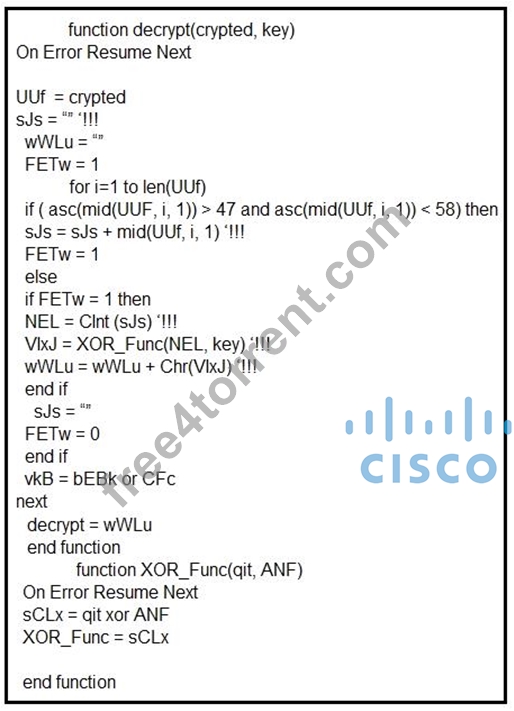
Which type of code created the snippet?
- A. Bash Script
- B. VB Script
- C. PowerShell
- D. Python
Answer: B
NEW QUESTION # 18
The Linux system administrator of a company suspects that physical unauthorized access was granted to a local Linux terminal. The administrator wants to examine the suspected machine for potential unauthorized use and to get information about even/ account in this terminal including when the password last changed The administrator logs in as a root user Which file should be examined to get the information?
- A. /etc/shadow
- B. /etc/passwd
- C. /etc/auth
- D. /etc/users
Answer: A
Explanation:
* /etc/shadow: This file stores encrypted passwords and password aging information, including the date of the last password change (stored as the number of days since January 1, 1970). It is only readable by the root user, making it the primary source for forensic auditing of local password changes.
NEW QUESTION # 19
A cybersecurity analyst is analyzing a complex set of threat intelligence data from internal and external sources. Among the data, they discover a series of indicators, including patterns of unusual network traffic, a sudden increase in failed login attempts, and multiple instances of suspicious file access on the company's internal servers. Additionally, an external threat feed highlights that threat actors are actively targeting organizations in the same industry using ransomware. Which action should the analyst recommend?
- A. Propose isolation of affected systems and activating the incident response plan because the organization is likely under attack by the new ransomware strain.
- B. Advocate providing additional training on secure login practices because the increase in failed login attempts is likely a result of employee error.
- C. Notify of no requirement for immediate action because the suspicious file access incidents are normal operational activities and do not indicate an ongoing threat.
- D. Advise on monitoring the situation passively because network traffic anomalies are coincidental and unrelated to the ransomware threat.
Answer: A
Explanation:
The described scenario includes both internal alerts (unusual network traffic, failed logins, suspicious file access) and external intelligence indicating active ransomware campaigns in the same industry. This constitutes a strong combination of precursors and indicators, as defined in the NIST SP 800-61 incident handling model and reinforced in the Cisco CyberOps Associate curriculum.
According to the Cisco guide:
* "Once an incident has occurred, the IR team needs to contain it quickly before it affects other systems and networks within the organization."
* "The containment phase is crucial in stopping the threat from spreading and compromising more systems".
Given these indicators and the high-value nature of the data involved, it is essential to proactively isolate suspected systems and activate the incident response plan to prevent damage from potential ransomware.
-
NEW QUESTION # 20
Refer to the exhibit.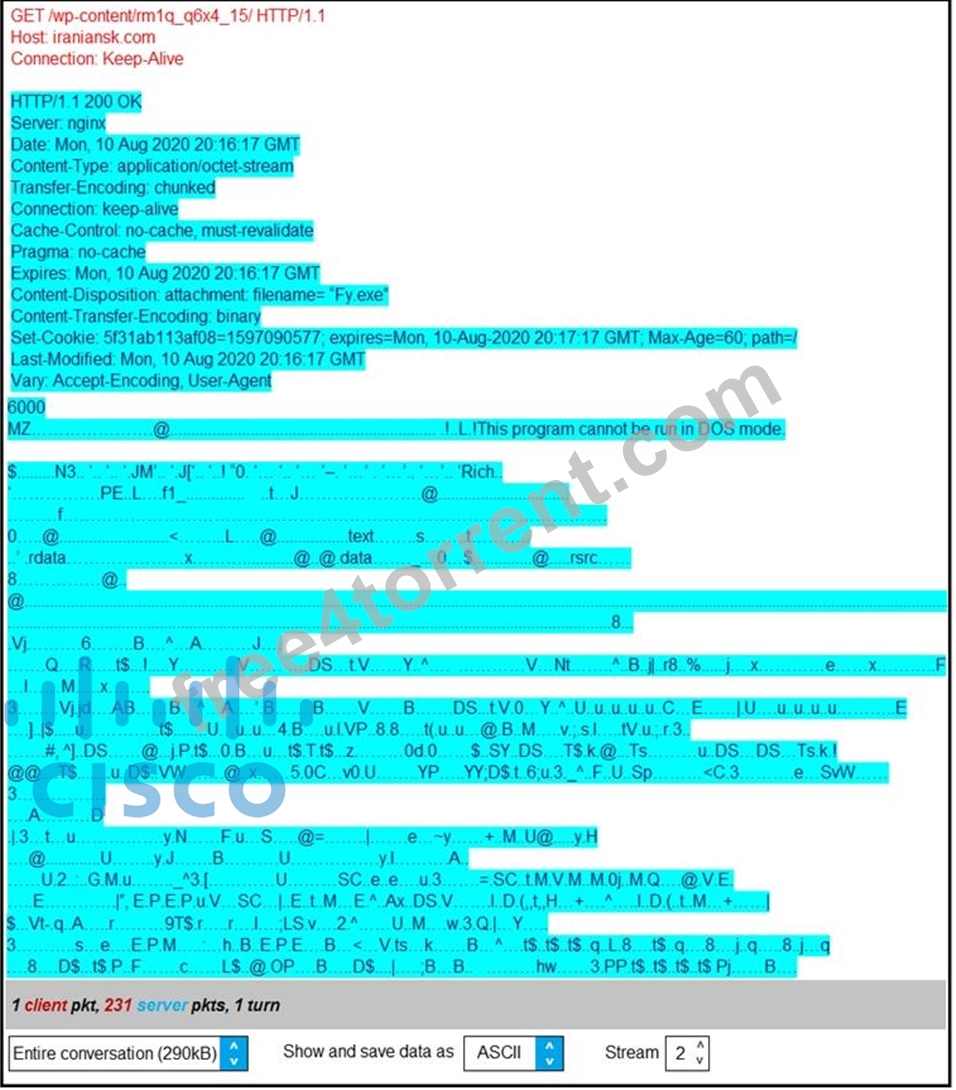
According to the Wireshark output, what are two indicators of compromise for detecting an Emotet malware download? (Choose two.)
- A. Domain name: iraniansk.com
- B. Hash value: 5f31ab113af08=1597090577
- C. Content-Type: application/octet-stream
- D. Server: nginx
- E. filename= "Fy.exe"
Answer: A,E
Explanation:
From the Wireshark capture:
* A (iraniansk.com): This domain isnot a known legitimate resourceand is hosting a suspicious file named "Fy.exe," strongly indicative of amalware distribution domain.
* D (Fy.exe): TheContent-Disposition: attachment; filename="Fy.exe"header explicitly signals abinary executabledownload, a key indicator in Emotet campaigns.
WhileContent-Type: application/octet-stream(E) is typical of binary data transfers, it isnot uniqueto malware and cannot by itself serve as a strong IoC. Thenginx server (B)andcookie/hash string (C)similarly do not uniquely indicate compromise.
NEW QUESTION # 21
A threat actor has successfully attacked an organization and gained access to confidential files on a laptop.
What plan should the organization initiate to contain the attack and prevent it from spreading to other network devices?
- A. attack surface
- B. intrusion prevention
- C. root cause
- D. incident response
Answer: D
Explanation:
Once an incident has occurred, the appropriate course of action is to engage the organization's Incident Response (IR) plan. This is a structured approach to contain, analyze, and eradicate threats before they spread across the network.
The Cisco CyberOps Associate study guide emphasizes:
* "Incident response and handling are essential within an organization... The main objective of implementing an incident handling process is to reduce the impact of a cyber-attack, ensure the damages caused are assessed, and implement recovery procedures".
* In particular, the containment phase of IR is focused on isolating the threat and preventing lateral movement or further compromise.
Options such as "root cause" or "attack surface" are relevant at later stages of analysis and mitigation, not immediate containment. Therefore, the correct answer is C.
NEW QUESTION # 22
Refer to the exhibit.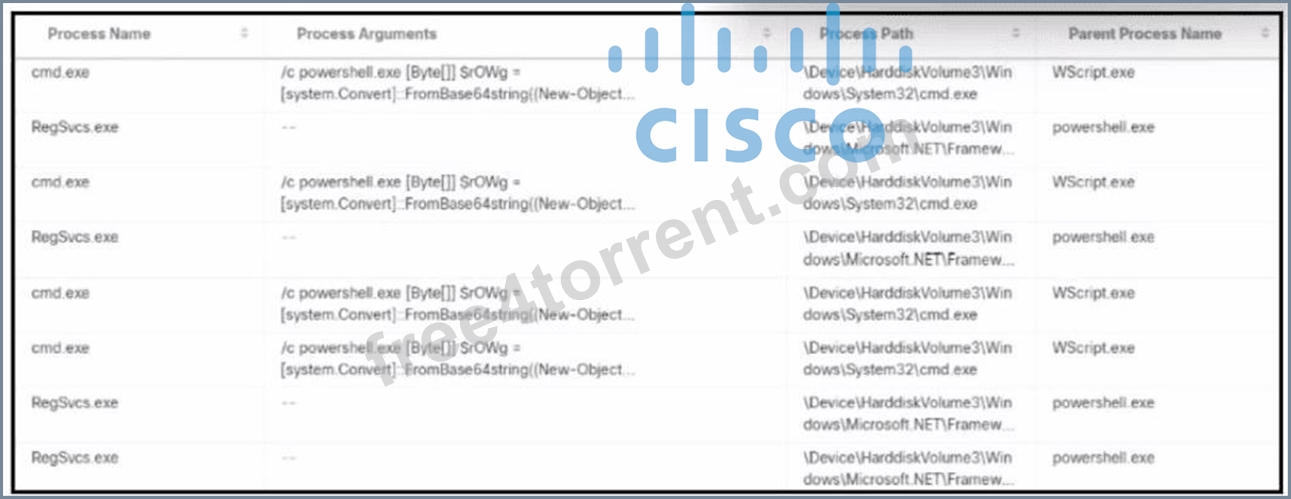
An alert came with a potentially suspicious activity from a machine in HR department. Which two IOCs should the security analyst flag? (Choose two.)
- A. powershell.exe used on HR machine
- B. cmd.exe starting powershell.exe with Base64 conversion
- C. WScript.exe initiated by powershell.exe
- D. WScript.exe acting as a parent of cmd.exe
- E. cmd.exe executing from \Device\HarddiskVolume3\
Answer: B,D
Explanation:
The exhibit shows a series of process executions that form a suspicious chain involving scripting engines and obfuscated commands:
* One critical indicator iscmd.exe executing PowerShell with obfuscated (Base64-encoded) arguments
. The use of Base64 is a known method used by attackers to mask malicious commands. This aligns with attack techniques defined under MITRE ATT&CK T1059 (Command and Scripting Interpreter) and T1086 (PowerShell abuse). Therefore, option D is valid.
* Another important IOC isWScript.exe acting as a parent of cmd.exe, which is abnormal in typical business environments. This indicates potential misuse of Windows Script Host (WSH) to launch commands, often seen in phishing or malware dropper scenarios. Thus, option E is also valid.
Options A and B by themselves are not definitive IOCs-PowerShell and cmd.exe are legitimate administrative tools and frequently used in Windows environments.
Option C is not supported by the exhibit-the reverse (powershell.exe initiated by WScript.exe) is what's seen, not the other way around.
These patterns align with theCyberOps Technologies (CBRFIR) 300-215 study guide, which specifies that chaining of interpreters (e.g., WScript # cmd # PowerShell) with encoded commands is a key indicator of compromise during forensic analysis.
Reference:CyberOps Technologies (CBRFIR) 300-215 study guide, Chapter on Identifying Malicious Activity in Host-Based Artifacts and Command-Line Analysis.
NEW QUESTION # 23
A security analyst receives a notification from SIEM that an internal host has active connections to Tor exit nodes. The analyst investigates SIEM events related to the workstation and identifies that the host scans networks for servers with an opened TCP port 1433 An antivirus scan of the workstation does not determine any suspicious activity Which two actions must the analyst take to mitigate this behavior? (Choose two.)
- A. Block any connection to TCP port 1433 from external sources.
- B. Create a Cisco Secure Network Analytics notification rule to further investigate port scanning activity
- C. Configure SIEM alert rules to perform quick response and mitigation
- D. Deploy EDR and SOAR for automatic quarantine of actions from suspicious hosts
- E. Block Tor nodes via an NGFW and restrict access to SQL only from trusted sources
Answer: A,C
NEW QUESTION # 24
Drag and drop the cloud characteristic from the left onto the challenges presented for gathering evidence on the right.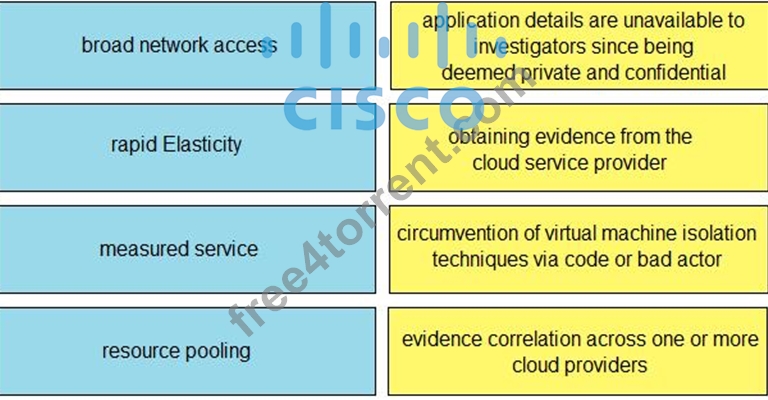
Answer:
Explanation: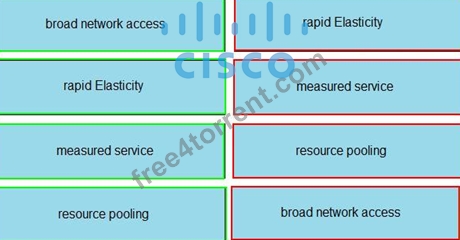
NEW QUESTION # 25
Refer to the exhibit.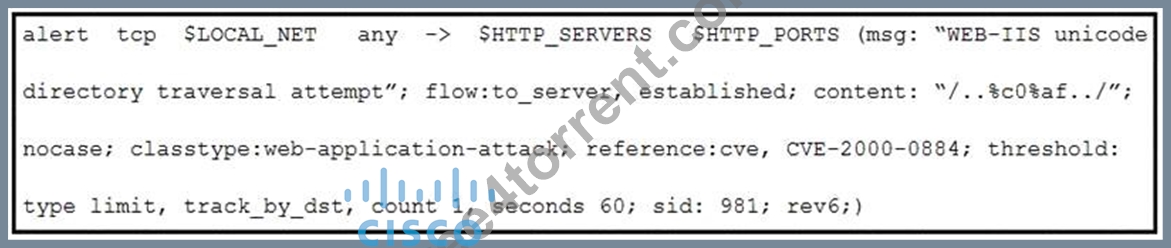
A company that uses only the Unix platform implemented an intrusion detection system. After the initial configuration, the number of alerts is overwhelming, and an engineer needs to analyze and classify the alerts.
The highest number of alerts were generated from the signature shown in the exhibit. Which classification should the engineer assign to this event?
- A. False Negative alert
- B. True Negative alert
- C. False Positive alert
- D. True Positive alert
Answer: C
Explanation:
The alert shown is based on a Snort rule for a Unicode directory traversal attack against IIS web servers (Microsoft platform). The key detail here is the payload content "../..%c0%af../" which is a classic IIS-specific exploit related to CVE-2000-0884.
Since the company only uses Unix systems, they are not vulnerable to this IIS-specific attack. Therefore, these alerts are triggered by irrelevant traffic or misapplied signatures, resulting in False Positives.
As defined in the Cisco CyberOps guide:
"False Positive: an alert is generated for traffic that is not actually malicious or relevant to the protected environment".
NEW QUESTION # 26
Refer to the exhibit.
A security analyst is reviewing alerts from the SIEM system that was just implemented and notices a possible indication of an attack because the SSHD system just went live and there should be nobody using it. Which action should the analyst take to respond to the alert?
- A. Reset the admin password in SSHD to prevent unauthorized access to the system at scale.
- B. Ignore the alert and continue monitoring for further activity because the system was just implemented.
- C. Investigate the alert by checking SSH logs and correlating with other relevant data in SIEM.
- D. Immediately block the IP address 192.168.1.100 from accessing the SSHD environment.
Answer: C
Explanation:
The log entry shows a failed SSH login attempt for an invalid user "admin" from IP 192.168.1.100. As the system has just gone live and no legitimate use is expected, this could be an early reconnaissance or brute- force attempt. However, blocking IPs or resetting passwords without fully understanding the context could lead to incomplete remediation or false positives.
According to Cisco CyberOps best practices, the first step is to thoroughly investigate the alert by correlating it with other logs (e.g., authentication logs, IDS/IPS logs) to determine the intent and scope of activity.
-
NEW QUESTION # 27 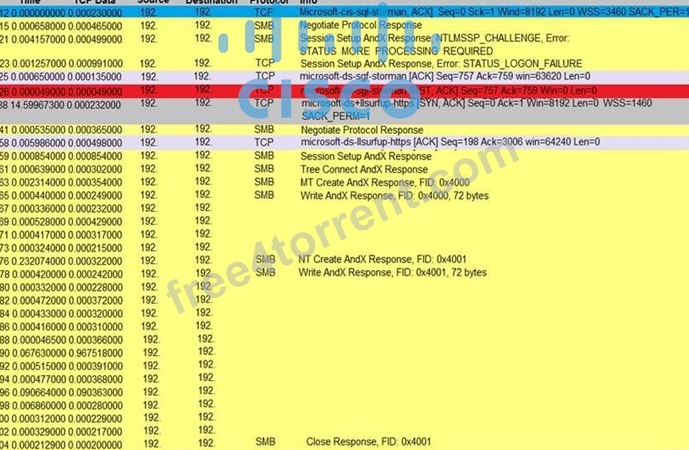
Refer to the exhibit. An engineer is analyzing a TCP stream in a Wireshark after a suspicious email with a URL. What should be determined about the SMB traffic from this stream?
- A. It is sharing access to files and printers.
- B. It is exploiting redirect vulnerability
- C. It is requesting authentication on the user site.
- D. It is redirecting to a malicious phishing website,
Answer: B
NEW QUESTION # 28
A cybersecurity analyst must identify an unknown service causing high CPU on a Windows server. What tool should be used?
- A. Process Explorer from the Sysinternals Suite to monitor and examine active processes
- B. TCPdump to capture and analyze network packets
- C. SIFT (SANS Investigative Forensic Toolkit) for comprehensive digital forensics
- D. Volatility to analyze memory dumps for forensic investigation
Answer: A
Explanation:
Process Explorer is an advanced Windows-based utility that shows real-time data about running processes, CPU usage, services, DLLs, and handles. It is specifically designed for this kind of investigation and is part of the Sysinternals Suite.
NEW QUESTION # 29
An incident responder reviews a log entry that shows a Microsoft Word process initiating an outbound network connection followed by PowerShell execution with obfuscated commands. Considering the machine's role in a sensitive data department, what is the most critical action for the responder to take next to analyze this output for potential indicators of compromise?
- A. Compare the metadata of the Microsoft Word document with known templates to verify its authenticity.
- B. Conduct a behavioral analysis of the PowerShell execution pattern and deobfuscate the commands to assess malicious intent.
- C. Correlate the time of the outbound network connection with the user's activity log to establish a usage pattern.
- D. Examine the network destination of the outbound connection to assess the credibility and categorize the traffic.
Answer: B
Explanation:
When dealing with suspected malicious activity involving obfuscated PowerShell scripts-especially when launched from Microsoft Word documents-behavioral analysis is the most critical next step. This approach helps in determining if the process chain is part of a known attack pattern, such as a phishing attempt using malicious macros that launch PowerShell for data exfiltration or payload download.
As highlighted in theCyberOps Technologies (CBRFIR) 300-215 study guide, understanding behavior and deobfuscating PowerShell scripts is an essential part of the forensic and incident response process.
Specifically:
* During the detection and analysis phase, if PowerShell is used with obfuscated or encoded commands, responders should investigate the intent and behavior of the command.
* Deobfuscation allows analysts to see what the script is doing (e.g., downloading files, creating persistence mechanisms, or opening a reverse shell).
The guide states:
"For example, if the threat is malware, the compromised system should be immediately isolated and the malware should be placed in a sandbox or a detonation chamber to understand what it is trying to do".
This confirms that understanding execution behavior (such as what the PowerShell script intends to perform) is key to uncovering indicators of compromise (IoCs).
Thus, option C-conducting a behavioral analysis and deobfuscating PowerShell-is the most critical and effective response at this stage.
NEW QUESTION # 30
Refer to the exhibit.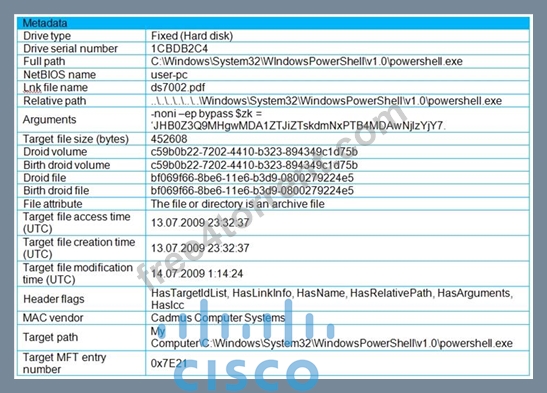
An engineer is analyzing a .LNK (shortcut) file recently received as an email attachment and blocked by email security as suspicious. What is the next step an engineer should take?
- A. Delete the suspicious email with the attachment as the file is a shortcut extension and does not represent any threat.
- B. Open the file in a sandbox environment for further behavioral analysis as the file contains a malicious script that runs on execution.
- C. Upload the file to a virus checking engine to compare with well-known viruses as the file is a virus disguised as a legitimate extension.
- D. Quarantine the file within the endpoint antivirus solution as the file is a ransomware which will encrypt the documents of a victim.
Answer: B
NEW QUESTION # 31
An "unknown error code" is appearing on an ESXi host during authentication. An engineer checks the authentication logs but is unable to identify the issue. Analysis of the vCenter agent logs shows no connectivity errors. What is the next log file the engineer should check to continue troubleshooting this error?
- A. var/log/general/log
- B. var/log/shell.log
- C. /var/log/syslog.log
- D. /var/log/vmksummary.log
Answer: C
Explanation:
Explanation/Reference: https://docs.vmware.com/en/VMware-vSphere/6.7/com.vmware.vsphere.monitoring.doc/GUID-
832A2618-6B11-4A28-9672-93296DA931D0.html
NEW QUESTION # 32
An engineer is analyzing a DoS attack and notices that the perpetrator used a different IP address to hide their system IP address and avoid detection. Which anti-forensics technique did the perpetrator use?
- A. onion routing
- B. cache poisoning
- C. spoofing
- D. encapsulation
Answer: C
Explanation:
Using adifferent IP addressto disguise the origin of an attack is the definition ofIP spoofing.
"Spoofing involves falsifying data, such as IP or MAC addresses, to hide the source of malicious activity." - Cisco CyberOps guide
NEW QUESTION # 33
Refer to the exhibit.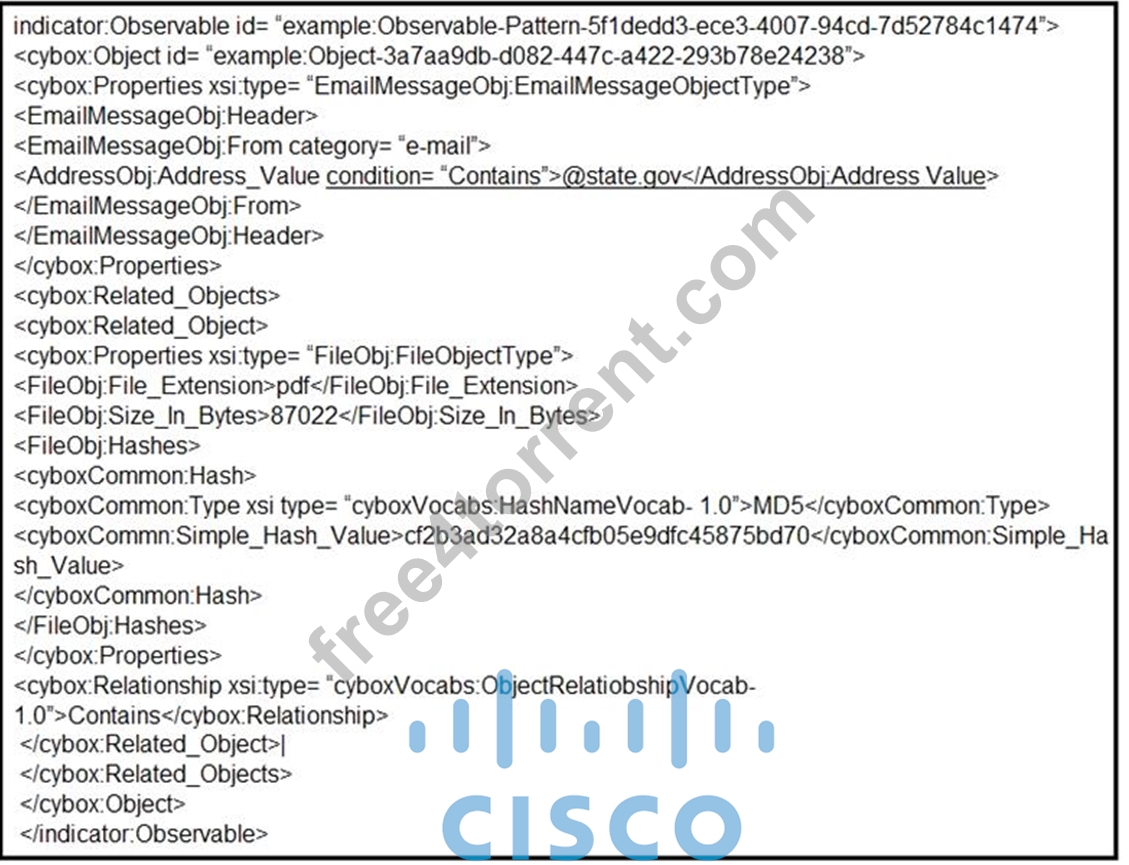
Which two actions should be taken as a result of this information? (Choose two.)
- A. Update the AV to block any file with hash "cf2b3ad32a8a4cfb05e9dfc45875bd70".
- B. Block emails sent from [email protected] with an attached pdf file with md5 hash "cf2b3ad32a8a4cfb05e9dfc45875bd70".
- C. Block all emails sent from an @state.gov address.
- D. Block all emails with pdf attachments.
- E. Block all emails with subject containing "cf2b3ad32a8a4cfb05e9dfc45875bd70".
Answer: A,C
NEW QUESTION # 34
Which type of record enables forensics analysts to identify fileless malware on Windows machines?
- A. PowerShell event logs
- B. network records
- C. file event records
- D. IIS logs
Answer: A
Explanation:
Fileless malwareoperates in memory and often leverages legitimate tools such asPowerShellto avoid traditional file-based detection. Since these threats don't leave typical file traces, analysts must rely on PowerShell event logsto trace suspicious or unauthorized script execution.
The Cisco CyberOps Associate guide explicitly states:
"PowerShell logs provide insight into script block execution and can reveal indicators of fileless attacks that reside in memory." Hence,PowerShell event logsare the most effective forensic source for detecting fileless malware activity on Windows systems.
NEW QUESTION # 35
......
300-215 dumps Sure Practice with 133 Questions: https://realtest.free4torrent.com/300-215-valid-dumps-torrent.html