

[May-2026] XK0-005 Dumps are Available for Instant Access using Free4Torrent
XK0-005 Dumps 2026 - New CompTIA XK0-005 Exam Questions
CompTIA XK0-005 exam covers a wide range of Linux-related topics, including system architecture, installation and package management, GNU and Unix commands, devices, and file systems. It also covers topics such as security, networking, and shell scripting. XK0-005 exam is performance-based, which means that test takers must demonstrate their ability to complete tasks related to Linux system administration, rather than just answering multiple-choice questions.
CompTIA Linux+ certification exam is intended for individuals who are interested in pursuing a career in Linux system administration. It is also suitable for professionals who want to enhance their knowledge and skills in Linux system administration. XK0-005 exam covers various topics, including Linux command line, Linux file system, user management, network configuration, shell scripting, and more. It also includes performance-based questions, which test the candidate's ability to perform real-world tasks on a Linux system.
The CompTIA Linux+ Certification Exam certification is ideal for IT professionals who work with Linux systems in their daily operations. This includes system administrators, network administrators, cybersecurity professionals, and other IT professionals who are responsible for managing Linux systems. The CompTIA Linux+ certification is recognized globally by technology companies and government agencies, making it a valuable certification to have for professionals seeking career advancement opportunities. Additionally, the certification is vendor-neutral, which means that it is not tied to any specific Linux distribution or technology provider.
NEW QUESTION # 444
Linux system users report that over the past few months, a server has stopped responding at least twice each day. Every time this happens, the users have to restart the server to recover it. A systems administrator diagnosing the issue collects the following outputs:
csharp
Output 1
[Tue Aug 31 16:36:42 2021] oom-killer invoked by java: gfp_mask=0x280da2 order=0, oom_score_adj=0
[Tue Aug 31 16:36:42 2021] java cpuset=/ mems_allowed=0 makefile
Output 2
[root@server]# free -m
total used free shared buff/cache available
Mem: 15819 15026 174 92 619 134
Swap: 0 0 0
Which of the following is the best permanent resolution for the system?
- A. More CPU resources
- B. Extended root filesystem
- C. More network bandwidth
- D. More memory resources
Answer: D
Explanation:
The oom-killer is invoked when the system runs out of memory, as indicated by the memory usage in the free -m output. Since swap space is not being used and physical memory is almost entirely consumed, adding more memory resources will prevent the system from running out of memory and invoking the oom-killer to terminate processes.
NEW QUESTION # 445
A Linux administrator is troubleshooting an issue in which users are not able to access https://portal.comptia.
org from a specific workstation. The
administrator runs a few commands and receives the following output: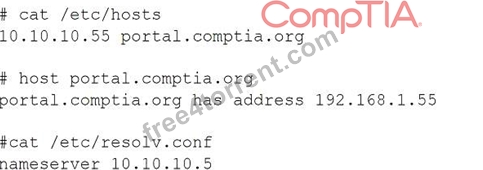
Which of the following tasks should the administrator perform to resolve this issue?
- A. Add a network route from the 10.10.10.0/24 to the 192.168.0.0/16.
- B. Remove the entry for portal . comptia.org from the local hosts file.
- C. Clear the local DNS cache on the workstation and rerun the host command.
- D. Update the name server in resolv. conf to use an external DNS server.
Answer: B
Explanation:
The best task to perform to resolve this issue is B. Remove the entry for portal.comptia.org from the local hosts file. This is because the local hosts file has a wrong entry that maps portal.comptia.org to 10.10.10.55, which is different from the actual IP address of 192.168.1.55 that is returned by the DNS server. This causes a mismatch and prevents the workstation from accessing the website. By removing or correcting the entry in the hosts file, the workstation will use the DNS server to resolve the domain name and access the website successfully.
To remove or edit the entry in the hosts file, you need to have root privileges and use a text editor such as vi or nano. For example, you can run the command:
sudo vi /etc/hosts
and delete or modify the line that says:
10.10.10.55 portal.comptia.org
Then save and exit the file.
NEW QUESTION # 446
A systems administrator needs to write a script that performs unattended package upgrades.
Which of the following flags should be used with either yum or apt to meet this goal?
- A. -q
- B. -y
- C. -u
- D. -d
Answer: C
NEW QUESTION # 447
A Linux systems administrator is setting up SSH access with PKI for several using their newly created RSA keys. Which of the following MOST securely achieves this task?
- A. Use cp to copy each user's public key file to the respective system
- B. Use ssh-copy-id to copy each user's private key file to the respective system
- C. Use curl to copy each user's public key file to the respective system
- D. Use ssh-copy-id to copy each user's public key file to the respective system
Answer: D
Explanation:
https://www.linode.com/docs/security/authentication/use-public-key-authentication-with-ssh/
NEW QUESTION # 448
A cloud engineer needs to change the secure remote login port from 22 to 49000. Which of the following files should the engineer modify to change the port number to the desired value?
- A. /etc/ssh/sshd_config
- B. /etc/hostname
- C. /etc/host.conf
- D. /etc/services
Answer: A
NEW QUESTION # 449
A Linux administrator rebooted a server. Users then reported some of their files were missing. After doing some troubleshooting, the administrator found one of the filesystems was missing. The filesystem was not listed in /etc/f stab and might have been mounted manually by someone prior to reboot. Which of the following would prevent this issue from reoccurring in the future?
- A. Mount the filesystem manually.
- B. Remount all the missing filesystems
- C. Sync the mount units.
- D. Create a mount unit and enable it to be started at boot.
Answer: D
NEW QUESTION # 450
A technician wants to configure a Unix server as a gateway firewall. The technician has implemented the proper ACLs and port address translation policies, but network traffic is not passing from the LAN to the WAN.
Which of the following should the technician configure to for this issue?
- A. DenyHouse
- B. Ip_forward
- C. /etc/service
- D. Squid-service
Answer: A
NEW QUESTION # 451
The administrator comptia is not able to perform privileged functions on a newly deployed system. Given the following command outputs: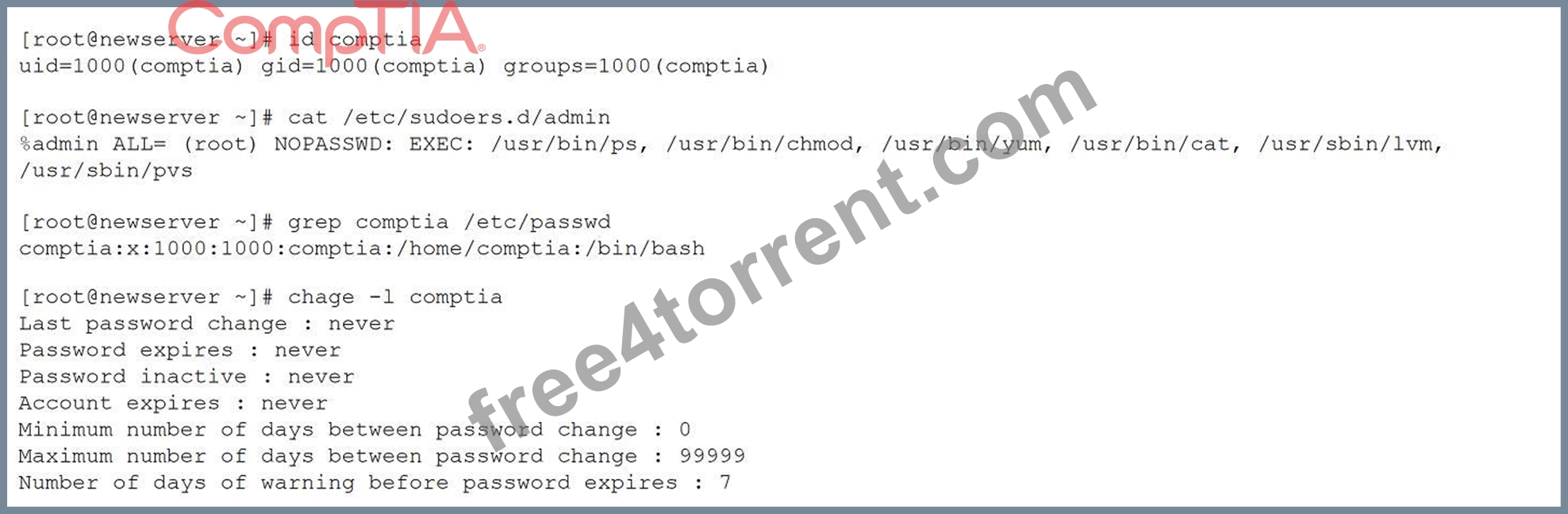
Which of the following is the reason that the administrator is unable to perform the assigned duties?
- A. The administrator's credentials need to be more complex.
- B. The administrator needs a password reset.
- C. The administrator is not a part of the correct group.
- D. The administrator did not update the sudo database.
Answer: C
Explanation:
The reason that the administrator is unable to perform the assigned duties is because the administrator is not a part of the correct group. This is option B.
Based on the image that you sent, I can see that the user comptia has a user ID and a group ID of 1000, and belongs to only one group, which is also comptia. However, the sudoers file, which defines the permissions for users to run commands as root or other users, does not include the comptia group in any of the entries.
Therefore, the user comptia cannot use sudo to perform privileged functions on the system.
The other options are incorrect because:
A: The administrator needs a password reset.
This is not true, because the password aging information for the user comptia shows that the password was last changed on Oct 24, 2023, and it does not expire until Jan 22, 2024. There is no indication that the password is locked or expired.
C: The administrator did not update the sudo database.
This is not necessary, because the sudo database is automatically updated whenever the sudoers file is modified. There is no separate command to update the sudo database.
D: The administrator's credentials need to be more complex.
This is not relevant, because the complexity of the credentials does not affect the ability to use sudo. The sudoers file does not specify any password policy for the users or groups that are allowed to use sudo.
NEW QUESTION # 452
Which of the following best explains why the SUID permission is set on the /bin/passwdfile?
- A. To indicate an attacker has compromised the system
- B. To ensure group permission on the /etc/passwdfile stay up to date
- C. To allow normal users to update the /etc/shadowfile
- D. To mark the /bin/passwdfile as immutable
Answer: C
Explanation:
The Set User ID (SUID) permission allows a file to execute with the privileges of the file owner, rather than the user who runs it.
The /bin/passwdcommand is used by users to change their own passwords. The actual password hashes are stored in /etc/shadow, which is only writable by the root user.
Since normal users do not have direct write permissions on /etc/shadow, the SUID bit on
/bin/passwdenables the command to run with root privileges, allowing password changes.
NEW QUESTION # 453
A systems administrator made some unapproved changes prior to leaving the company. The newly hired administrator has been tasked with revealing the system to a compliant state. Which of the following commands will list and remove the correspondent packages?
- A. dnf info and dnf upgrade
- B. dnf history and dnf history undo last
- C. dnf remove and dnf check
- D. dnf list and dnf remove last
Answer: B
Explanation:
The commands that will list and remove the corresponding packages are dnf history and dnf history undo last.
The dnf history command will display a list of all transactions performed by dnf, such as installing, updating, or removing packages. Each transaction has a unique ID, a date and time, an action, and a number of altered packages. The dnf history undo last command will undo the last transaction performed by dnf, meaning that it will reverse all package changes made by that transaction. For example, if the last transaction installed some packages, dnf history undo last will remove them.
The other options are not correct commands for listing and removing corresponding packages. The dnf list command will display a list of available packages in enabled repositories, but not the packages installed by dnf transactions. The dnf remove command will remove specified packages from the system, but not all packages from a specific transaction. The dnf info command will display detailed information about specified packages, but not about dnf transactions. The dnf upgrade command will upgrade all installed packages to their latest versions, but not undo any package changes. References: Handling package management history; dnf(8) - Linux manual page
NEW QUESTION # 454
A systems administrator is tasked with mounting a USB drive on a system. The USB drive has a single partition, and it has been mapped by the system to the device /dev/sdb. Which of the following commands will mount the USB to /media/usb?
- A. mount /dev/sdb0 /media/usb
- B. mount /dev/sdb /media/usb
- C. mount /dev/sdb1 /media/usb
- D. mount -t usb /dev/sdb1 /media/usb
Answer: C
Explanation:
The mount /dev/sdb1 /media/usb command will mount the USB drive to /media/usb. This command will attach the filesystem on the first partition of the USB drive (/dev/sdb1) to the mount point /media/usb, making it accessible to the system. The mount /dev/sdb0 /media/usb command is invalid, as there is no such device as /dev/sdb0. The mount /dev/sdb /media/usb command is incorrect, as it will try to mount the entire USB drive instead of its partition, which may cause errors or data loss. The mount -t usb /dev/sdb1 /media/usb command is incorrect, as usb is not a valid filesystem type for mount. Reference: CompTIA Linux+ (XK0-005) Certification Study Guide, Chapter 14: Managing Disk Storage, page 455.
NEW QUESTION # 455
Some servers in an organization have been compromised. Users are unable to access to the organization's web page and other services. While reviewing the system log, a systems administrator notices messages from the kernel regarding firewall rules: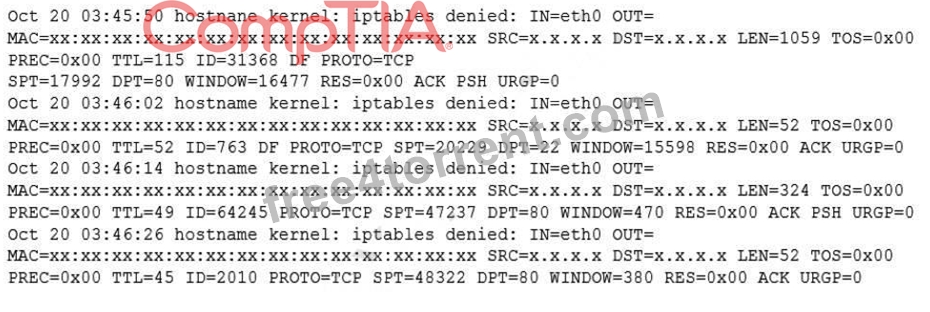
Which of the following commands will remediate and help resolve the issue?
- A.

- B.

- C.

- D.

Answer: B
Explanation:
The command iptables -F will remediate and help resolve the issue. The issue is caused by the firewall rules that block the access to the organization's web page and other services. The output of dmesg | grep firewall shows that the kernel has dropped packets from the source IP address 192.168.1.100 to the destination port 80, which is the default port for HTTP. The command iptables -F will flush all the firewall rules and allow the traffic to pass through. This command will resolve the issue and restore the access to the web page and other services. The other options are incorrect because they either do not affect the firewall rules (ip route flush or ip addr flush) or do not exist (iptables -R). References: CompTIA Linux+ (XK0-005) Certification Study Guide, Chapter 18: Securing Linux Systems, page 543.
NEW QUESTION # 456
A Linux administrator is configuring a new internal web server fleet. The web servers are up and running but can only be reached by users directly via IP address. The administrator is attempting to fix this inconvenience by requesting appropriate records from the DNS team. The details are:
Hostname: devel.comptia.org
IP address: 5.5.5.1, 5.5.5.2, 5.5.5.3, 5.5.5.4
Name server: 5.5.5.254
Additional names: dev.comptia.org, development.comptia.org
Which of the following types of DNS records should the Linux administrator request from the DNS team? (Choose three).
- A. SOA
- B. TXT
- C. NS
- D. A
- E. MX
- F. SRV
- G. RRSIG
- H. PTR
- I. CNAME
Answer: C,D,I
Explanation:
NS - to delegate the zone "comptia.org" (or its subdomain) to the name server at 5.5.5.254.
A - to map devel.comptia.org to the four IP addresses (5.5.5.1, .2, .3, .4).
CNAME - to create the aliases dev.comptia.org and development.comptia.org pointing at devel.comptia.org.
NEW QUESTION # 457
A systems administrator pressed Ctrl+Z after starting a program using the command line, and the shell prompt was presented. In order to go back to the program, which of the following commands can the administrator use?
- A. fg
- B. ed
- C. bg
- D. su
Answer: A
Explanation:
Ctrl+Z suspended the process, and "fg" will bring it back into the foreground of the shell A Comprehensive and Detailed Explanation: To go back to a program that was suspended by pressing Ctrl+Z in the command line, the command that can be used is fg. The fg command stands for foreground, and it resumes the job that is next in the queue and brings it to the foreground. Alternatively, if there are more than one suspended jobs, fg can be followed by a job number to resume a specific job. The other commands are incorrect because they either do not resume a suspended job, or they have different functions such as switching user (su), pushing a job to the background (bg), or editing a file (ed). References: CompTIA Linux+ Study Guide, Fourth Edition, page 181-182.
NEW QUESTION # 458
A Linux engineer has been notified about the possible deletion of logs from the file /opt/app/logs. The engineer needs to ensure the log file can only be written into without removing previous entries.
Which of the following commands would be BEST to use to accomplish this task?
- A. chattr +c /opt/app/logs
- B. chattr +i /opt/app/logs
- C. chattr +a /opt/app/logs
- D. chattr +d /opt/app/logs
Answer: C
Explanation:
The command chattr +a /opt/app/logs will ensure the log file can only be written into without removing previous entries. The chattr command is a tool for changing file attributes on Linux file systems.
The +a option sets the append-only attribute, which means that the file can only be opened in append mode for writing. This prevents the file from being modified, deleted, or renamed. This is the best command to use to accomplish the task. The other options are incorrect because they either set the wrong attributes (+d, +i, or +c) or do not affect the file at all (-a). References: CompTIA Linux+ (XK0-005) Certification Study Guide, Chapter 11: Managing Files and Directories, page 357.
NEW QUESTION # 459
An administrator notices the HISTSIZE variable is 50, using the commands below:
HISTSIZE=50
export HISTSIZE
The administrator rechecks the HISTSIZE value using echo HISTSIZE but gets no value.
Which of the following commands should the administrator use to retrieve its value?
- A. echo HISTSIZE
- B. printf HISTSIZE
- C. printenv | grep $HISTSIZE
- D. grep $HISTSIZE
Answer: C
NEW QUESTION # 460
A Linux administrator is trying to remove the ACL from the file /home/user/data. txt but receives the following error message:
Given the following analysis: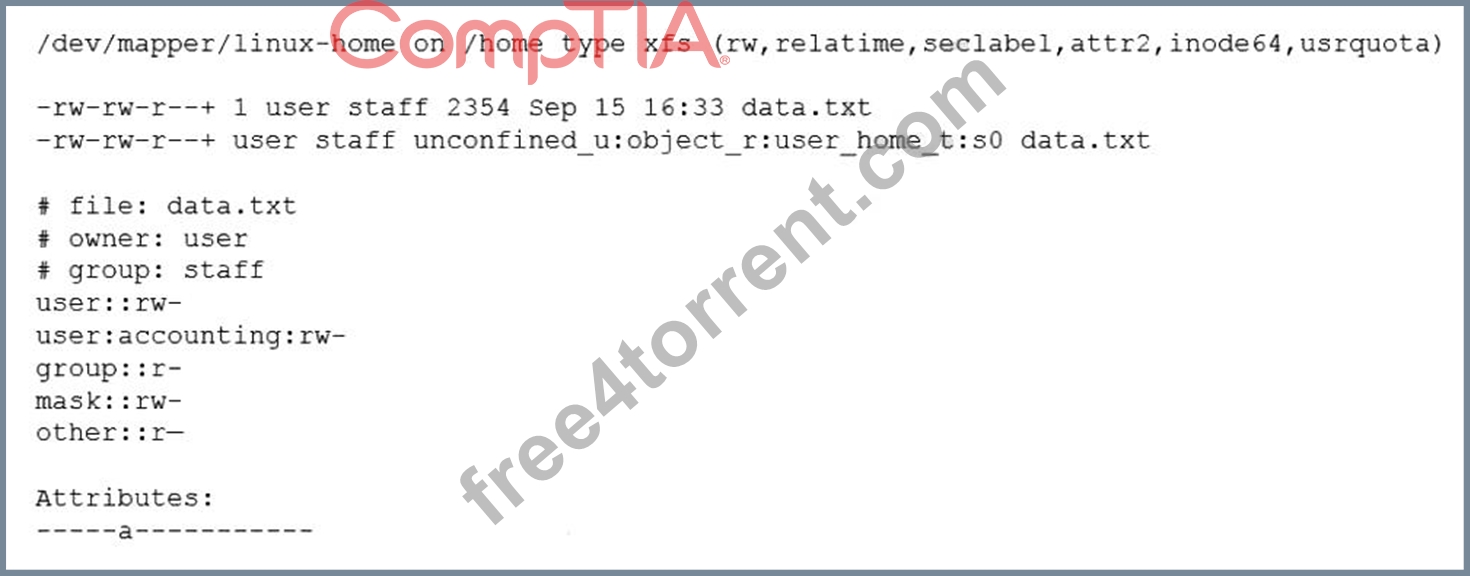
Which of the following is causing the error message?
- A. The filesystem is mounted with the wrong options.
- B. File attributes are preventing file modification.
- C. SELinux file context is denying the ACL changes.
- D. The administrator is not using a highly privileged account.
Answer: B
Explanation:
Explanation
File attributes are preventing file modification, which is causing the error message. The output of lsattr
/home/user/data.txt shows that the file has the immutable attribute (i) set, which means that the file cannot be changed, deleted, or renamed. The command setfacl -b /home/user/data.txt tries to remove the ACL from the file, but fails because of the immutable attribute. The administrator needs to remove the immutable attribute first by using the command chattr -i /home/user/data.txt and then try to remove the ACL again. The other options are incorrect because they are not supported by the outputs. The administrator is using a highly privileged account, as shown by the # prompt. The filesystem is mounted with the correct options, as shown by the output of mount | grep /home. SELinux file context is not denying the ACL changes, as shown by the output of ls -Z /home/user/data.txt. References: CompTIA Linux+ (XK0-005) Certification Study Guide, Chapter 11: Managing Files and Directories, pages 357-358.
NEW QUESTION # 461
A network administrator issues the dig www.comptia.org command and receives an NXDOMAIN response.
Which of the following files should the administrator check first?
- A. /etc/sysconfig/network-scripts
- B. /etc/hosts
- C. /etc/nsswitch.conf
- D. /etc/resolv.conf
Answer: D
Explanation:
Step-by-Step Comprehensive Detailed Explanation:
Command Explanation:
The dig command queries DNS servers. If NXDOMAIN is received, the system cannot resolve the domain.
The /etc/resolv.conf file contains the DNS server configuration.
Why Other Options are Incorrect:
B: /etc/hosts maps IP addresses to hostnames but is not queried unless configured in /etc/nsswitch.conf.
C: /etc/sysconfig/network-scripts contains network interface configurations, unrelated to DNS.
D: /etc/nsswitch.conf defines the order of name resolution methods, but it does not directly resolve domain names.
References:
CompTIA Linux+ Study Guide: Network Configuration
man dig
NEW QUESTION # 462
Which of the following is a function of a bootloader?
- A. It triggers the start of all the system services.
- B. It initializes all the devices that are required to load the OS.
- C. It mounts the root filesystem that is required to load the OS.
- D. It helps to load the different kernels to initiate the OS startup process.
Answer: D
Explanation:
A function of a bootloader is to help load the different kernels to initiate the OS startup process. A bootloader is a program that runs when the system is powered on and prepares the system for booting the OS. A bootloader can load different kernels, which are the core components of the OS, and pass the control to the selected kernel. A bootloader can also provide a menu for the user to choose which kernel or OS to boot.
NEW QUESTION # 463
......
CompTIA XK0-005 Exam Practice Test Questions: https://realtest.free4torrent.com/XK0-005-valid-dumps-torrent.html