

1z0-076 by Oracle Actual Free Exam Questions And Answers [UPDATED 2025]
1z0-076 Questions Truly Valid For Your Oracle Exam!
Oracle 1z0-076 Exam Syllabus Topics:
| Topic | Details |
|---|---|
| Topic 1 |
|
| Topic 3 |
|
| Topic 4 |
|
| Topic 5 |
|
| Topic 6 |
|
| Topic 7 |
|
| Topic 8 |
|
| Topic 9 |
|
NEW QUESTION # 43
Examine the Data Guard configuration: DGMGRL> show configuration;
Configuration - Animals
Protection Mode: MaxPerformance
Databases:
dogs- Primary database
sheep - Physical standby database
cats- Snapshot standby database
Fast-Start Failover: DISABLED
Configuration Status: SUCCESS
You receive an error while attempting to raise the protection mode to Maximum Protection:
DGMGRL> edit configuration set protection mode as maxprotection;
Error: ORA-16627: operation disallowed since no standby databases would remain to support protection mode Failed.
What can you conclude based on this error?
- A. The redo transport mode is set to async for both standby databases.
- B. The redo transport mode is set to asyn: for the standby database Cats.
- C. The redo transport mode is set to async for the standby database Sheep.
- D. Cats is a snapshot standby database.
Answer: D
Explanation:
Comprehensive Detailed Explanation:
In an Oracle Data Guard environment, the Maximum Protection mode requires that all redo data be transmitted synchronously to at least one standby database, ensuring no data loss even in the event of a primary database failure. However, a snapshot standby database, by its nature, allows read-write access and is temporarily disconnected from the redo stream, which makes it unable to participate in the synchronous redo transport required by Maximum Protection mode. The presence of a snapshot standby database in the Data Guard configuration thus prevents the activation of Maximum Protection mode, as it cannot guarantee zero data loss without a standby database capable of receiving redo data synchronously.
Reference:
Oracle Data Guard documentation clearly outlines the requirements and restrictions of different protection modes, including the necessity for standby databases to participate in synchronous redo transport to enable Maximum Protection mode. The inability of snapshot standby databases to fulfill this requirement is a key consideration when planning Data Guard configurations and protection levels.
Explanation:
The error indicates that switching the protection mode to Maximum Protection is not possible due to the presence of a snapshot standby database in the Data Guard configuration, which cannot participate in synchronous redo transport required by the Maximum Protection mode. Therefore, the correct answer is:
NEW QUESTION # 44
Your current Data Guard environment consists of:
A primary database containing no abstract data types used for user tables.
Two separate remote physical standby databases used for reporting.
Examine these requirements for adding a new standby database to this Data Guard environment:
The new standby database must provide a disaster recovery solution.
There must be minimal additional performance overheads on the primary database.
The new standby database may require additional indexes and materialized views not present in the primary.
New tables or schemas may be required in the standby database that are not present in the primary.
What would you recommend to fulfill these requirements?
- A. A physical standby database with synchronous redo transport and Real-Time Query enabled.
- B. A logical standby database with asynchronous redo transport and SQL apply on.
- C. A logical standby database with synchronous redo transport and redo apply on.
- D. A logical standby database with synchronous redo transport and SQL apply on.
- E. A physical standby database with asynchronous redo transport and Real-Time Query enabled.
Answer: B
NEW QUESTION # 45
Which two Data Guard features require the use of flashback database by the broker?
- A. Far Sync Instances
- B. Read-Mostly physical standby implementations
- C. Fast-Start Failover
- D. Snapshot Standby databases
- E. Real Time Query
Answer: C,D
NEW QUESTION # 46
Which THREE statements are true about snapshot standby databases?
- A. A snapshot standby database may be opened read-write.
- B. FLASHBACK DATABASE is enabled automatically on a physical standby database as part of the conversion into a snapshot standby database, if not already enabled.
- C. FLASHBACK DATABASE must be manually enabled on a physical standby database before converting it into a snapshot standby database.
- D. A snapshot standby database may be opened read-only.
- E. FLASHBACK DATABASE is enabled automatically on a snapshot standby database after converting it from a physical standby database if not already enabled.
- F. A snapshot standby database can have Real-Time apply enabled.
Answer: A,B,E
Explanation:
Snapshot standby databases are a feature of Oracle Data Guard that allows a physical standby database to be temporarily converted into a read-write database for testing or other purposes. The true statements about snapshot standby databases are:
FLASHBACK DATABASE is enabled automatically on a snapshot standby database after converting it from a physical standby database if not already enabled (B): When a physical standby is converted to a snapshot standby, FLASHBACK DATABASE is automatically enabled to allow the database to be easily reverted back to its original state.
FLASHBACK DATABASE is enabled automatically on a physical standby database as part of the conversion into a snapshot standby database, if not already enabled (C): As part of the conversion process, FLASHBACK DATABASE is turned on to ensure that changes made while the database is in snapshot standby mode can be undone.
A snapshot standby database may be opened read-write (E): Once a physical standby is converted to a snapshot standby, it can be opened for read-write operations, allowing for testing and other tasks that require a writable database.
Reference:
Oracle Data Guard Concepts and Administration
Oracle Database Backup and Recovery User's Guide
NEW QUESTION # 47
Which four requirements can be met by deploying a logical standby database?
- A. It can be used to create additional tables.
- B. Support for workloads requiring additional materialized views.
- C. It can be used to create additional schemas.
- D. Support for workloads requiring additional indexes.
- E. It must have the same physical structure as the primary database.
- F. It must provide a disaster-recovery solution that protects all data with capability of performing switchovers and failovers.
- G. It can be used for Real Application Testing without affecting the disaster recovery capabilities.
Answer: A,B,D,G
Explanation:
A logical standby database is part of Oracle Data Guard and allows the standby database to be open for read-write operations, providing additional flexibility. The requirements met by a logical standby database include:
* Support for workloads requiring additional materialized views (A): Logical standby databases can support materialized views, allowing for complex data summarization and reporting workloads.
* It can be used to create additional tables (C): Unlike physical standby databases, logical standby databases allow for the creation of additional tables that do not exist in the primary database, enabling custom workloads and reporting.
* It can be used for Real Application Testing without affecting the disaster recovery capabilities (E):
Logical standby databases can be used to test application changes, patches, and upgrades while still maintaining their role as part of the disaster recovery strategy.
* Support for workloads requiring additional indexes (F): Logical standby databases allow for the creation of additional indexes to optimize query performance for reporting and analytical workloads.
References:
* Oracle Data Guard Concepts and Administration
* Oracle Database High Availability Overview
NEW QUESTION # 48
Your Data Guard environment has two remote physical standby databases.
Client applications use the local naming method to define connectivity to the primary database instance.
Which will automatically redirect clients to the new primary database in case of a switchover or failover?
- A. Set the DB_NAME parameter identically on all databases; modify the connection descriptor on the clients to use DB_NAME to connect to the primary database instance.
- B. Configure a PRIMARY role service on the Primary and Standby and modify the Client connect descriptor to include both the Primary and the Standby.
- C. Create a database service on the standby databases; automate the start of the service after a role change, and modify the connection descriptor on the clients to use that service.
- D. Set the LOCAL_LISTENER parameter for all the database instances, to register services with the default listener on the primary database host.
Answer: C
NEW QUESTION # 49
Which THREE statements are TRUE about Global Sequences when connected to a physical standby database with Real-Time Query enabled?
- A. Their usage will always have a performance impact on the primary database.
- B. Their creation requires that a LOG archive_dest_n parameter be defined in the standby that points back to the primary.
- C. They must have the NOORDEK and CACHE options set.
- D. Their usage may have a performance impact on the physical standby database if the CACHE size is too small.
- E. If the CACHE option is set then the size of the cache must be at least 100.
Answer: A,C,D
Explanation:
Global Sequences are Oracle sequences that generate unique values across multiple instances in an Oracle RAC or a Data Guard configuration. Regarding their behavior and performance when connected to a physical standby database with Real-Time Query enabled:
* A: The usage of Global Sequences can indeed have a performance impact on the primary database due to the need to generate unique values that are consistent across both primary and standby databases.
* D: The performance impact on the physical standby database may occur if the CACHE size is too small. This is because the standby database will frequently have to access the primary database to replenish the cache, which can increase the load and potentially lead to performance degradation.
* E: Global Sequences should have the NOORDER and CACHE options set. The NOORDER option ensures that sequence numbers are provided without guaranteeing sequence order, thus improving scalability and performance. The CACHE option is used to specify how many sequence values will be held in memory for faster access.
Option B is incorrect as the LOG_ARCHIVE_DEST_n parameter's definition for standbys pointing back to the primary does not directly pertain to the creation of sequences.
Option C is incorrect because there is no requirement that the size of the cache for a sequence must be at least
100. The CACHE size can be set to a different number based on specific use cases or performance considerations.
References: Oracle's documentation on sequences and their behavior in a Data Guard environment provides insights into the performance considerations and best practices for using sequences, particularly in a Real-Time Query context.
NEW QUESTION # 50
Which THREE statements are TRUE about the supported workload in Active Data Guard standby databases?
- A. Read-mostly reporting applications that use global temporary tables for storing temporary data can be offloaded.
- B. The DML operations on a standby can be transparently redirected to and run on the primary database
- C. The DDL operations on private temporary tables are transparently redirected to the primary database.
- D. You might have to use sequences with global temporary tables to support read-mostly applications by using Active Data Guard.
- E. PL/SQL blocks that you run on Active Data Guard standby databases can be always redirected to and run on the primary database.
Answer: A,B,D
Explanation:
In an Oracle Active Data Guard environment:
* B: Read-mostly reporting applications that utilize global temporary tables to store session-specific data can be effectively offloaded to an Active Data Guard standby database, reducing the load on the primary database.
* C: Sequences can be used with global temporary tables on an Active Data Guard standby database to support certain types of read-mostly applications, though some restrictions on sequence use may apply.
* E: In Oracle Database 19c and later, DML redirection allows DML operations performed on an Active Data Guard standby database to be transparently redirected to the primary database. This is part of the DML Redirection feature.
Option A is incorrect because not all PL/SQL blocks run on an Active Data Guard standby database can be redirected to the primary database. Some PL/SQL executions, specifically those that would attempt to make changes to the database, are not supported on the standby.
Option D is incorrect because DDL operations on private temporary tables are not redirected; instead, private temporary tables are session-specific and are not persisted on disk, so they do not generate redo and are not applicable to an Active Data Guard standby.
References: The behavior and capabilities of Active Data Guard standby databases are documented in the Oracle Data Guard Concepts and Administration guide and the Active Data Guard documentation.
NEW QUESTION # 51
Active Data Guard (ADG) databases are widely used to offload reporting or ad hoc query-only jobs from the primary database. Reporting workload profile is different from the primary database and often requires tuning.
Which tool is used to tune SQL workloads running on an ADG database?
- A. Automatic Diagnostic Database Monitor (ADDM)
- B. In-Memory Active Session History (ASH)
- C. Standby Statspack
- D. SQL Tuning Advisor
- E. Automatic Workload Repository (AWR)
Answer: E
Explanation:
AWR collects, processes, and maintains performance statistics for problem detection and self-tuning purposes.
In an Active Data Guard environment, where the physical standby database can be used for read-only workloads, AWR can be instrumental in identifying performance bottlenecks and areas for optimization. It provides detailed reports that include wait events, time model statistics, and active session history, making it an invaluable tool for tuning SQL queries and overall database performance in an ADG setup.
NEW QUESTION # 52
Which FOUR database parameters might be affected by or influence the creation of standby databases?
- A. FALSERVER
- B. ARCHIVE_LAG_TARGET
- C. STANDBY_ARCHIVE_DEST
- D. db_file_name_convert
- E. COMPATIBLE
- F. DB_NAME
Answer: C,D,E,F
Explanation:
* DB_NAME (A): The name of the database, which should remain consistent across the primary and standby databases.
* db_file_name_convert (C): This parameter helps define the mapping of data file names from the primary to the standby database, which is crucial during the creation and operation of a standby database.
* COMPATIBLE (D): The compatibility level can influence the features that can be used on the standby database and must be consistent with or higher than that of the primary database, especially after upgrades.
* STANDBY_ARCHIVE_DEST (F): This parameter specifies the destination of archived redo log files on the standby database, which is important for log transport and apply services.
References:
* Oracle Data Guard Concepts and Administration Guide
* Oracle Database Reference
NEW QUESTION # 53
Which two are prerequisites for configuring Transaction Guard in a Data Guard environment?
- A. Create a database service with COMMIT_OUTCOME set to TRUE, and ensure clients use that service to connect to the database instance.
- B. Grant execute permission on the DBMS_APP_CONT package to relevant database schema owners.
- C. Ensure that connection descriptors for database clients use the failover clause with the COMMIT_OUTCOME parameter set to TRUE.
- D. Set INSTANCE_NAME identically on all the Data Guard Configuration databases and modify the local service name on the client to include a CONNECTION_LIST containing all the standby hosts.
- E. Create a database service with COMMIT_OUTCOME set to TRUE and ensure that the service is statically registered with the default listener on the primary host.
Answer: A,B
NEW QUESTION # 54
Which THREE are among the various tasks performed by the Data Guard Monitor (DMON) process?
- A. communicating with dkon processes in other database instances that are part of the broker configuration
- B. performing role transitions when switchover requests are made
- C. maintaining information about all members of the broker configuration in binary configuration files.
- D. communicating with the DMON process of the observer to monitor a primary database in case a fast start failover is required
- E. activating role-based services appropriately in the various database instances of the configuration, based on the database role
Answer: B,C,E
Explanation:
The Data Guard Monitor (DMON) process is a key component of Oracle Data Guard. It plays a crucial role in managing and monitoring the state of both the primary and standby databases in a Data Guard configuration.
* Performing role transitions when switchover requests are made (A): DMON is responsible for coordinating the switchover process between the primary and standby databases. This involves safely transitioning the roles of the databases to ensure data protection and availability.
* Maintaining information about all members of the broker configuration in binary configuration files (B): DMON maintains detailed information about the databases in the Data Guard configuration, including their roles, states, and network addresses. This information is stored in binary configuration files, which are used by the Data Guard Broker to manage the Data Guard environment.
* Activating role-based services appropriately in the various database instances of the configuration, based on the database role (C): DMON activates services that are appropriate for the role of each database in the Data Guard configuration. For example, it may activate different services on a primary database than on a standby database, based on the specific requirements of each role.
References:
* Oracle Data Guard Concepts and Administration
* Oracle Data Guard Broker documentation
NEW QUESTION # 55
Which two steps must be performed before running DUPLICATE TARGET DATABASE FOR STANDBY using RMAN?
- A. Transfer a copy of the password file from the primary host to the standby host.
- B. Create an SPFILE for the standby database.
- C. Configure Oracle Net connectivity between the primary host and the standby host.
- D. Run the nid utility to modify the DBID of the primary database.
- E. Create a standby control file.
Answer: A,C
NEW QUESTION # 56
Which three are true concerning database states after a successful switchover?
- A. The former primary database will always be open.
- B. The new primary database will be open read-write.
- C. If the former primary database became a logical standby database it will be open read-write.
- D. If the former primary database became a physical standby database it will always be open readonly.
- E. If the former primary database became a physical standby database it will be in the same state as the former physical standby database.
- F. If the former primary database became a logical standby database it will be in mount state.
Answer: B,C,E
Explanation:
After a successful switchover operation in a Data Guard environment, the new primary database (the former standby) will be open read-write (option A). If the former primary database transitions to a logical standby database, it will also be open read-write (option C), allowing it to apply redo data while servicing read-only queries. The former primary, if converted to a physical standby, will adopt the state that the former physical standby database was in prior to the switchover, which can vary based on the configuration prior to the switchover (option D). The state of a physical standby database can range from mounted to open read-only, depending on whether Real-Time Query was enabled. Thus, the exact state will depend on the pre-switchover setup. It's also essential to highlight that options B and E suggest specific states for a former primary turned logical standby, and a former primary turned physical standby, respectively, but these states are not fixed and depend on the configurations set up by the database administrators. Reference: The answers are corroborated by Oracle's documentation on Data Guard switchovers, specifically in the Oracle Data Guard Concepts and Administration guide, which explains the roles and states of databases in a Data Guard configuration before and after switchovers.
NEW QUESTION # 57
Which three Data Guard monitoring activities may be performed using Enterprise Manager Cloud Control?
- A. You can check the potential data loss in the event of a disaster.
- B. You can monitor the redo apply rate on a logical standby database.
- C. You can set a critical threshold on the redo generation rate metric for a primary database.
- D. You can monitor the redo apply rate on a snapshot standby database.
- E. You can check if redo apply needs to be tuned.
- F. You can set a warning threshold on the redo generation rate metric for a physical standby database.
Answer: A,B,C
Explanation:
Enterprise Manager Cloud Control offers comprehensive monitoring capabilities for Oracle Data Guard environments. It enables monitoring the rate at which redo is being applied on a logical standby database (A), which is crucial for ensuring that the standby database is keeping up with the changes from the primary. It also allows setting thresholds on performance metrics, such as the redo generation rate on the primary database (B), to alert administrators when values exceed critical or warning thresholds. Additionally, it provides the capability to estimate the potential data loss in the event of a disaster (E), helping in disaster recovery planning and ensuring business continuity.
Reference:
Oracle Enterprise Manager Cloud Control documentation provides extensive information on its monitoring features for Oracle Data Guard, including setting thresholds, estimating potential data loss, and tracking redo apply rates.
NEW QUESTION # 58
Which two are prerequisites for configuring flashback database for Oracle 19c databases, in a Data Guard environment?
- A. A fast recovery area must be configured.
- B. A far sync instance must be configured to flash back a standby when the primary has been flashed back.
- C. The database must be in ARCHTVELOG mode.
- D. The Data Guard real-time apply feature must be enabled.
- E. The data guard broker must be used.
Answer: A,C
Explanation:
* A fast recovery area must be configured (B): Flashback Database requires a fast recovery area to be set up because flashback logs are stored there. The fast recovery area is a unified storage location for all recovery-related files and activities.
* The database must be in ARCHIVELOG mode (C): Flashback Database operation relies on the ability to archive redo logs. Therefore, the database must be running in ARCHIVELOG mode for Flashback Database to be enabled.
References:
* Oracle Database Backup and Recovery User's Guide
* Oracle Data Guard Concepts and Administration Guide
NEW QUESTION # 59
On your logical standby database, you specified these rules: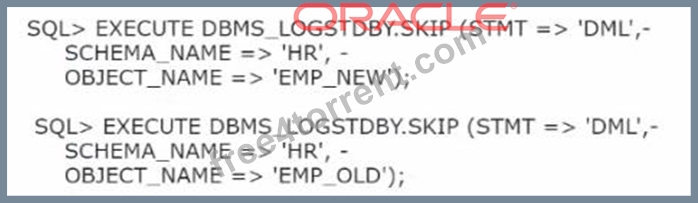
After completion of the weekend batch cycle you attempt to delete the SQL Apply filters:
Which is TRUE regarding the execution of the UNSKIP procedure?
- A. It returns an error because the syntax to delete a SQL Apply filter must specify the same object names as specified when the filter was added.
- B. It succeeds only if all DML statements executed on the primary have been applied on the logical standby deleting the SQL Apply filter.
- C. It succeeds only if SQL apply is stopped before deleting the SQL Apply filter.
- D. It deletes both the SQL Apply filters.
- E. It succeeds but the SQL Apply filters are not deleted.
Answer: D
Explanation:
The execution of the UNSKIP procedure is designed to remove SQL Apply filters that have been previously set up on a logical standby database. Based on the provided statements, the UNSKIP procedure is directed to delete any SQL Apply filters for DML statements associated with objects in the 'HR' schema that start with 'EMP'. Since both SKIP procedures had the same schema name ('HR') and statement type ('DML'), and the UNSKIP procedure uses a wildcard (%) for the object name, it will successfully remove both of the SQL Apply filters for 'EMP_NEW' and 'EMP_OLD', as both object names match the pattern provided in the UNSKIP procedure.
Reference:
Oracle's Data Guard documentation and SQL Language Reference provide insights into managing SQL Apply filters on a logical standby database using the DBMS_LOGSTDBY package. This includes adding and removing filters through SKIP and UNSKIP procedures.
NEW QUESTION # 60
You are licensed to use Oracle Active Data Guard.
Which TWO statements are true after enabling block change tracking on a physical standby database?
- A. It allows fast incremental backups to be offloaded to a snapshot standby database, when the physical standby database is converted.
- B. It starts the RVWR process on the physical standby database instance.
- C. It allows fast incremental backups to be offloaded to the physical standby database.
- D. It starts the CTWR process on the physical standby database instance.
- E. It allows fast incremental backups to be taken on the primary database.
- F. It starts the CTWR process on the primary database instance.
Answer: B,C
Explanation:
Block change tracking is a feature that enhances the efficiency of incremental backups by recording changed blocks in a tracking file. When used with Oracle Active Data Guard:
* It starts the RVWR process on the physical standby database instance (A): When block change tracking is enabled on a physical standby database, the Recovery Writer (RVWR) process is initiated.
This process is responsible for recording the changes to blocks in the block change tracking file, which is then used to optimize incremental backups.
* It allows fast incremental backups to be offloaded to the physical standby database (E): With block change tracking enabled on the physical standby database, fast incremental backups can be offloaded from the primary database. This reduces the workload on the primary database and utilizes the standby database for backup operations, improving overall system performance and efficiency.References:
* Oracle Database Backup and Recovery User's Guide
* Oracle Active Data Guard documentation
NEW QUESTION # 61
Which THREE statements are true about Far Sync instances?
- A. They use an spfMe, a standby controlfile, and standby redo logs.
- B. A primary database can ship redo directly to multiple Far Sync instances.
- C. They enable standby databases to be configured at remote distances from the primary without impacting performance on the primary.
- D. The Data Guard Broker must be used to deploy and manage Far Sync instances.
- E. They work with any protection level.
Answer: B,C,D
Explanation:
Far Sync instances are a feature of Oracle Data Guard designed to support zero data loss protection over long distances:
The Data Guard Broker must be used to deploy and manage Far Sync instances (A): Data Guard Broker simplifies the deployment and management of Far Sync instances, which are an integral part of zero data loss protection configurations.
They enable standby databases to be configured at remote distances from the primary without impacting performance on the primary (C): Far Sync instances are designed to receive redo from the primary database and then forward it to a remote standby database, thereby avoiding any performance impact on the primary database itself.
A primary database can ship redo directly to multiple Far Sync instances (E): A primary database can be configured to send redo logs to more than one Far Sync instance, which can then forward the redo to their respective remote standby databases.
Reference:
Oracle Data Guard Concepts and Administration Guide
Oracle Database High Availability Overview
NEW QUESTION # 62
......
Get instant access of 100% real exam questions with verified answers: https://realtest.free4torrent.com/1z0-076-valid-dumps-torrent.html